
Lt. Col. Netanel Makayes and reservist Yair Ansbacher revisit Rachel Cohen’s home with photographer Ziv Koren, recalling the ruined holiday table, the four Lotar fighters killed that day and the moment Ansbacher broke down beside Makayes
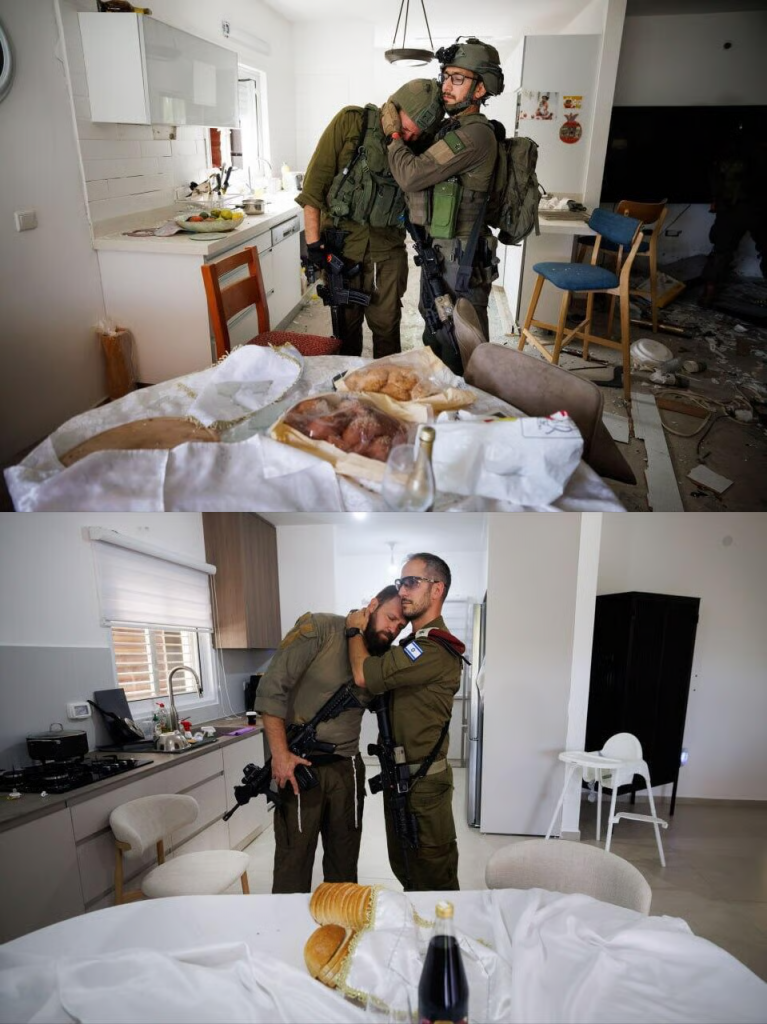
In uniform, standing beside the ruined holiday table in Rachel Cohen’s home in Kfar Aza, Yair rests his head against Netanel and bursts into tears. “We are human beings before we put on uniforms. We saw devastation,” the two said as they looked again at the photograph taken just two days after the Oct. 7 massacre.
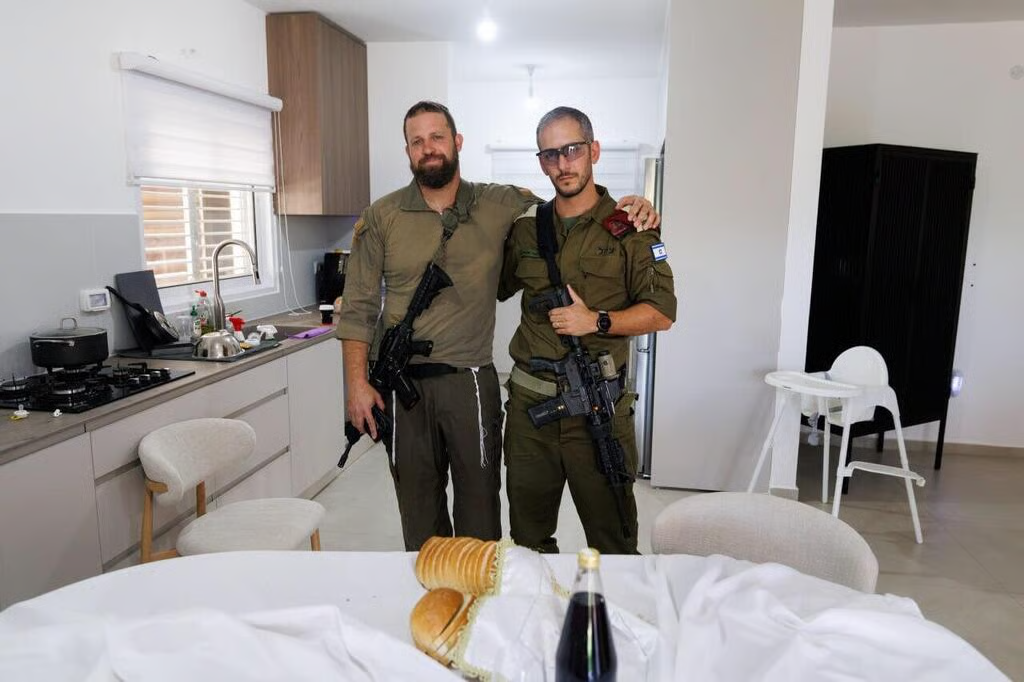
Now, three years later, they have returned to the same house, the same table and the same memory.
(Photo: Ziv Koren)
A day before the war broke out, Lt. Col. Netanel Makayes, then head of Lotar, the IDF Counterterrorism School, landed in Israel after returning from a military delegation to the United States. On the morning of Saturday, Oct. 7, he woke to a phone call from a friend who lived near the unit’s base.
“Bro, I need you to help me with a force,” the friend told him. “Something crazy is happening in the south.”
After speaking with a team commander in the unit and receiving information through his wife, Adi, a Magen David Adom paramedic, Makayes decided to leave his home in Zikhron Ya’akov, saying goodbye to her and their daughter Tamar.
Sgt. 1st Class (res.) Yair Ansbacher also immediately understood what was happening. He said goodbye to his wife, Naama, and their five children and headed south, where he joined a force from the Counterterrorism School.
“We knew war was coming,” Ansbacher, who had worked in security research, said. “The moment I woke to the sirens in Jerusalem and saw the image of the pickup truck in Sderot, I knew a full-scale war had begun. It’s in our DNA to get up and move, going from zero to 100 in an instant.”
At the entrance to the Urim base, Makayes assembled a team from fighters already in the area. During the fighting, Ansbacher and another soldier joined him. The battle continued until Makayes received an order over the radio to head to Kibbutz Nir Yitzhak, where troops had gathered residents and were defending them.
That night, the two learned that the unit’s former commander, Lt. Col. Eli Ginsberg, had been killed. “To this day, I still can’t believe Eli was killed,” Makayes said. “He was an incredible fighter, someone you felt could not be hurt.”
On Oct. 7, the Lotar unit lost four of its fighters and commanders: Staff Sgt. Ben Rubinshtain, Master Sgt. (res.) Omri Belkin, Maj. (res.) Roee Negri and Maj. (res.) Sagi Golan.
The photograph taken on Oct. 9, 2023, came during a mission led by Lotar and marked the first time photographer Ziv Koren joined them. “No one was dealing with the media at the time, but the unit understood how important it was,” Ansbacher said of the decision to bring a photojournalist along. “They cleared the destruction very quickly. People did not see what we saw.”
With Koren accompanying them, the troops entered Kfar Aza. “It was still a combat zone. There were encounters, bodies scattered around, everything destroyed,” Ansbacher recalled. “You could clearly see where the fire had burned everything, where everything was scorched and riddled with holes, and where ordinary life had been.”
While documenting the devastation, they entered Rachel Cohen’s home. “At the entrance, there was still a sukkah with family photographs inside,” Makayes recalled. “There were two challahs on the table, and all around them were shrapnel, blood and destruction.”
(Photo: Ziv Koren)
It was there that Koren’s camera captured an unguarded moment between the two fighters. Standing beside the holiday table, Ansbacher could no longer hold back his tears. “That moment shook me to my core. Netanel was beside me and supported me. I didn’t even know Ziv had taken the picture,” Ansbacher said.
“Yair is like my brother,” Makayes added. “The melting pot of the military and the intensity of combat connect and unite people.”
“We all cried there. It was a breaking point. There wasn’t a dry eye left,” Koren said. He said the image became a symbol in Israel and abroad because of the powerful emotion it conveys. “That moment, fighters standing in front of a holiday table with challah and wine on it, breaking down after days of fighting,” he said. “All the elements came together in that photograph. Someone looking at it can undergo a profound emotional experience and identify with that sense of rupture.”
Three years later, the three men returned to the entrance of the same home. “Each of us remembers a different detail,” Koren said. “The home blessing hanging by the entrance, the cabinet with the dishes, the bullet holes in the walls.”
“Since Oct. 7, I’ve been back to the kibbutzim dozens of times. I know every house here and the story of every person who was wounded, kidnapped or murdered,” Koren said. “Now I’m here with them, as they return for the first time since then. It’s deeply moving to come back together to the place where that moment, which became a symbol, was captured.”
As reported by Ynetnews