
In interview accompanying new book, B’Yachad party head recounts PM’s lack of orderly handover and threats to mark him as traitor, says his own actions as PM were key to recent successes against Iran
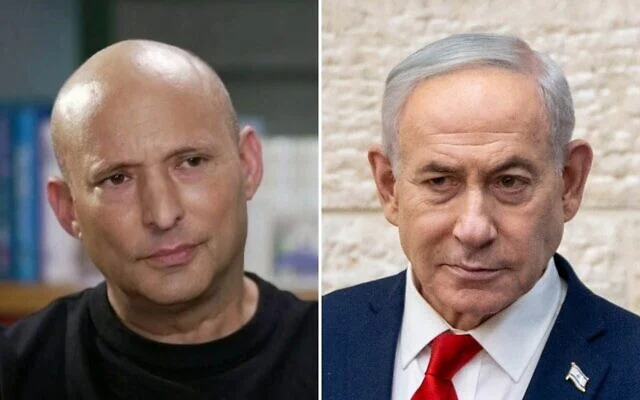
Former prime minister and the current head of the B’Yachad party Naftali Bennett denounced Prime Minister Benjamin Netanyahu as an “anarchist” whose toxic campaigning could put main rival Gadi Eisenkot in physical danger ahead of the October 27 election.
Bennett made the comments in a wide-ranging interview with Channel 12 broadcast on Saturday that accompanies the release of a new book by journalist Ari Shavit, titled “Bennett: Hour of Truth,” based on dozens of conversations between the two.
Bennett, a right-wing former Netanyahu ally who unseated the longtime premier to create his so-called “change government” with centrist, left-wing and Arab parties in 2021-2022, alleged that a pro-Netanyahu “poison machine” — including the Likud campaigns and a network of pro-Netanyahu media and social media outlets, headed by the Channel 14 network — has since created a false image of him as power-hungry and obsessive for the post of prime minister, arguing that his real motive is to save the country.
In recent months, Bennett’s alliance with Opposition Leader Yair Lapid has consistently lost ground in opinion polls, with the centrist Yashar party chief Gadi Eisenkot becoming the main rival to Netanyahu.
“I’m running for prime minister, with by far the most experience [in the anti-Netanyahu bloc],” Bennett told Channel 12, while adding: “I will do anything that guarantees victory for the bloc. One minute after the election we will go into a room, Gadi, [Yisrael Beytenu party head Avigdor Liberman] and the whole bloc, and we will exit with a single candidate. I won’t do anything that endangers the replacement of the government, and if I need to be in the most junior position in the world — so be it.”
Bennett also recounted the 2021 handover meeting with Netanyahu upon becoming prime minister, which lasted just 30 minutes.
“It was pretty amazing. I arrived prepared for a serious handover; I cleared my whole day for it,” he said.
In the book, Bennett says Netanyahu looked “pitiful, uptight, frayed, grumpy.”
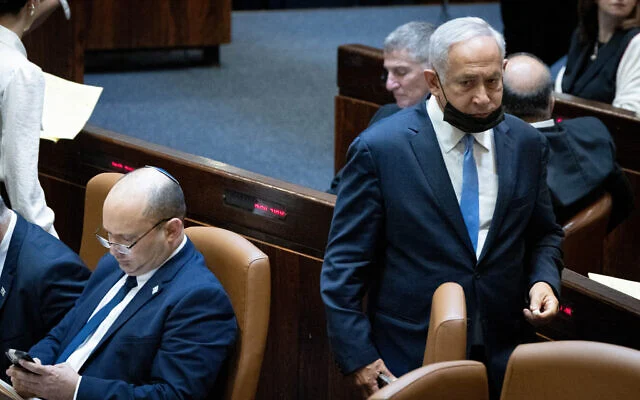
He told the network that while Netanyahu mumbled and didn’t volunteer information about diplomatic and security matters, signaling he just wanted to end the meeting and declining to wish him luck, he did request to stay at the prime minister’s residence for a few months — which Bennett refused — and for his wife Sara to continue getting a state-funded vehicle and security for a long period, which Bennett said he thinks he accepted.
The book says Bennett got the impression of “rage, unstatesmanlikeliness, unprofessionalism and perfunctoriness.”
He said he was “shocked” by the virulence of the anti-Bennett public campaign that Netanyahu and sympathetic media immediately embarked on in 2021 after he broke an on-air pre-election promise not to team up with the anti-Netanyahu bloc.
Bennett said Netanyahu invited him to his home a bit before the new government was sworn in, and told him: “Listen, if you form a government, I will employ all the heavy artillery to mark you as a traitor, and you will be ruining your whole life, you will always carry that stain.”
According to the book, Netanyahu also threatened to do to him what he did to Gideon Sa’ar — another former Netanyahu ally who broke ranks and joined the opposition. (Sa’ar has since returned to Netanyahu’s Likud party and is the current foreign minister.)
Bennett said Netanyahu made such threats repeatedly throughout that conversation and warned that Bennett wasn’t understanding the gravity of what he was about to face: “And he was right, I had wildly underestimated it. He opened the gates of hell on me; all hell broke loose. It was insane.”
He said that this time he is more prepared, but voiced fear that the Likud-led campaign against him, Eisenkot, Liberman and Yair Golan will get to the point that some people will think they “are Hitler and will make a move.”
While he himself has security as a former prime minister, Bennett said Eisenkot, who doesn’t have security, is in potential danger. “The scale of the daily brainwashing on Channel 14, in the [poison] machine’s elements, is something very, very powerful.”
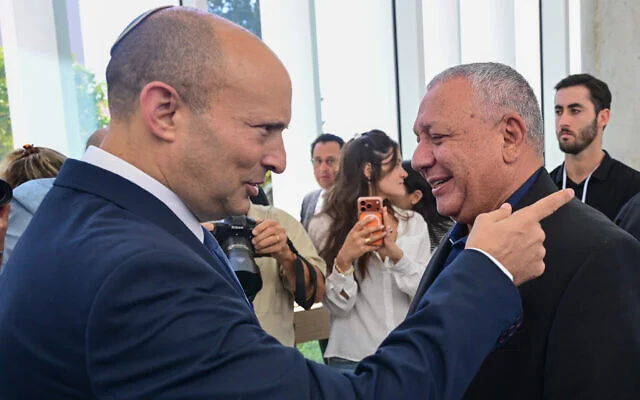
Further Bennett quotes were then read out from the book: “The composed, levelheaded statesman I knew and respected a decade ago was replaced by an authoritarian, unbridled person who forgot how to be a democrat and forgot the secret to the Jewish people’s power. He doesn’t genuinely believe in the power of the nation of Israel — only in his own power. As far as he is concerned, he is Gulliver surrounded by Lilliputs, and as a result, his leadership style is monarchical.”
“I was amazed how the conservative had become a revolutionary, and how the American Republican had become a sort of French king,” Bennett is quoted as saying in the book, adding in the interview that he would now go beyond “revolutionary” and describe Netanyahu as “almost an anarchist. What we are going through over the past few years is anarchy in the State of Israel.”
He was not asked how describing Netanyahu’s leadership as both authoritarian and anarchist reconciles with one another.
Bennett claimed the watershed moment in Netanyahu’s transition was the day Bennett’s government was sworn in in June 2021, when “he switched into a mode of ‘I’m burning down the country.’”
He said he hasn’t previously said such strong words about the premier because he now has “the perspective of the four most terrible years the State of Israel has gone through,” which “almost brought Israel to a state of destruction.”
Bennett said that while in the past he had opposed term limits for prime ministers, he is now “certain” they are needed: “I’m not ashamed to change my stance in the face of a new reality.”
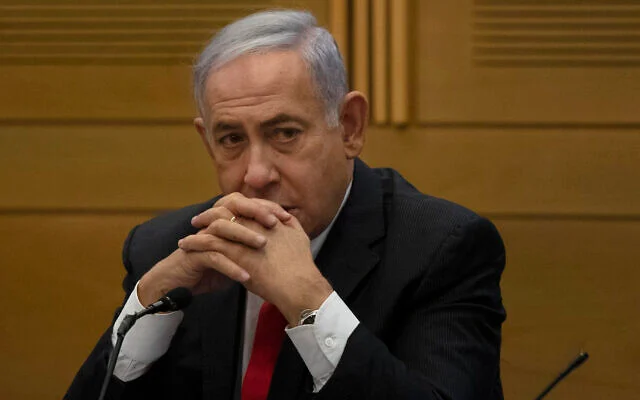
On Iran, Bennett accused Netanyahu of being responsible for “the biggest security failure in Israel’s history,” claiming that between 2018 and 2021, while Iran stepped up its uranium enrichment from under 3 percent to over 60%, Israel did “nothing” — didn’t collect intelligence, didn’t make attack plans, and didn’t start producing the “special means needed to destroy Iran’s air defenses.”
He said nobody in the security cabinet during this time, including him, knew about any of this because Iran was never discussed in the high-level forum.
Bennett said that when he discovered this as prime minister, he started closing this gap, and claimed that this was the only reason why the recent military campaigns against Iran, which included disabling the Islamic Republic’s air defenses and bombing sensitive nuclear sites, were successful.
Asked why longtime political partner Ayelet Shaked isn’t a part of his current political comeback after spending the last four years out of politics, Bennett said he still respects her but that they are no longer aligned in their political vision.
“There are many people who are still talking about a right-wing bloc or a left-wing bloc. I’m very much not there, and I think she is,” he said, adding that Shaked would have been on the B’Yachad slate “had she been of my current opinion, that we should set aside the ideological politics, and focus on saving the country.”
As reported by The Times of Israel