
In first Hebrew media interview of election campaign, PM says full unity not possible but that he seeks to form broad gov’t after election that will include far-right, Haredi parties and continue judicial overhaul
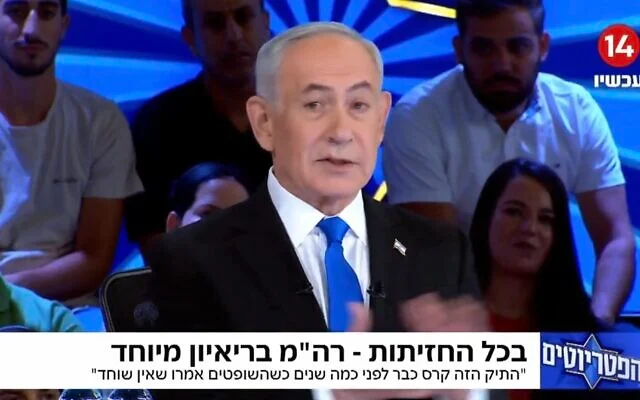
Prime Minister Benjamin Netanyahu asserted on Tuesday that his pursuit of “total victory” against Iran and its proxies “never ends,” as he touted what he said have been Israel’s military gains over the past three years, while insisting that more work was left to do.
In a rare TV Hebrew media interview — albeit on his Channel 14 mouthpiece network — Netanyahu was asked whether his Gaza war pledge to achieve “total victory” is still in force.
“It never ends. Do you want to live in the Middle East or in the world? You have to be very strong. And we are very strong. Israel is stronger than it has ever been, and we have put off threats and weakened (our adversaries) considerably. We have more work to do. We will take care of what is left of the Iranian axis,” Netanyahu said to applause from the supportive audience.
The premier touted Israel’s killing of much of the leadership of Hamas, Hezbollah and Iran as well as the buffer zones Israel has established in Gaza, Lebanon and Syria, even as he appeared to acknowledge that the results of the Iran war fell short of the more definitive war aims he initially set to destroy Iran’s nuclear and missile programs and to help spark regime change.
Netanyahu has previously argued that Israel will have to forever live by the sword in a world full of adversaries bent on its destruction, but the approach has exposed him to criticism from political opponents who have accused him of extending wars in Gaza and elsewhere in the region in order to remain in power, given that his coalition partners have threatened to collapse his government if he adopted more conciliatory policies.
Leaders abroad have argued Netanyahu’s hardline approach — particularly since Hamas’s October 7 onslaught — has not actually addressed the threats Israel faces and has harmed opportunities for regional integration.
“You can’t just kill your way out of solving every single national security problem that you have,” US Vice President JD Vance said in June, as he voiced frustration with Israel’s policies in Lebanon and with the criticism voiced by far-right members of Netanyahu’s government to Washington’s deal to end the war with Iran.
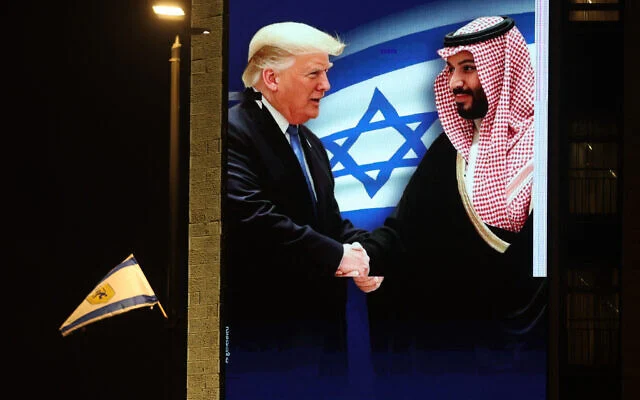
Saudi officials have also repeatedly made clear that they have no interest in normalizing relations with Israel absent Jerusalem agreeing to establish an irreversible pathway toward the establishment of a Palestinian state.
But Netanyahu was unfazed on Tuesday, insisting that additional peace deals between Israel and its neighbors are still possible, even as he made opposition to a Palestinian state a condition for joining the “broad national government” he is seeking to form after the fall election.
Asked to specify which countries he expects to reach peace agreements with, and if they include Saudi Arabia, Netanyahu declined to name them but insisted several countries are in contention, including Lebanon: “I’m not naming names because I want to deliver results. But everyone will see them… there are understandings with Lebanon that nobody foresaw. There are contacts with other countries as well. I can’t elaborate.”
“When you’re strong, people form alliances with you, and they make peace with you as well,” he said.
Asked if there will be a third confrontation with Iran after wars in June 2025 and earlier this year, Netanyahu replied: “If necessary,” repeating his vow that, “as long as I am prime minister, Iran will not have nuclear weapons.”
On Gaza, he was asked whether past proposals for the “voluntary emigration” of Gazans remain under consideration after being roundly rejected by much of the international community, which accused backers of the idea of trying to ethnically cleanse Gaza of its Palestinians. Netanyahu declined to elaborate, saying: “I prefer to talk less and do more.”
He was similarly noncommittal when asked about the prospect of renewed Israeli settlement in Gaza, saying only that “sometimes it’s advisable to separate” actions from public statements, and that “therefore, I have nothing further to add on that matter.” In the past, he had ruled out Gaza settlements, but appears to be adapting his public stance as elections approach.
Netanyahu said that Israel achieved two of three Gaza war aims: returning the hostages and eliminating Hamas as a military threat.
“The first objective, of course, was to bring back all of our hostages. And we achieved that,” he says, without noting that some hostages were killed in captivity or died before being recovered.
“The second objective was to dismantle Hamas and ensure that Gaza would no longer pose a military threat to Israel. And at the moment, it doesn’t,” he added, pointing out that there was no military response from Hamas after the recent assassination of its top official, Izz al-Din al-Haddad.
“We are in control. We are squeezing them. We also had a third objective, and that objective has not yet been achieved: eliminating their civilian rule. We will get there. There is still work to do. But there are constant operations targeting those who participated in October 7,” he said, adding that “we will find” anyone who remains who planned or participated in the attack.
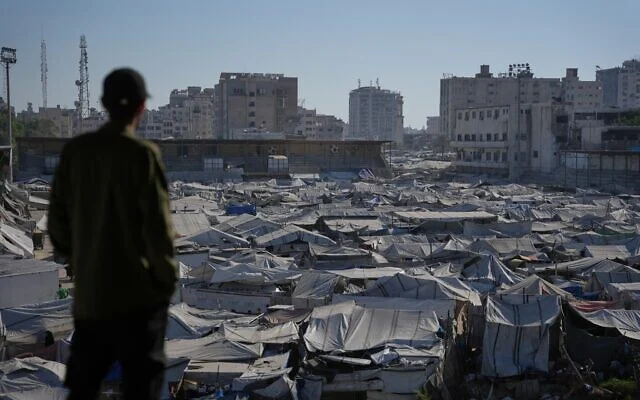
Netanyahu was also asked growing concern in Jerusalem over an allegedly expanded Egyptian military footprint in the Sinai Peninsula, which Jerusalem is said to claim violates the demilitarization clauses of their 1979 peace treaty with Cairo.
“I have held discussions with the Egyptians, and I told them what I expect to be done. Part of it is already being carried out. These are matters that simply involve upholding the agreements between us,” he said, without elaborating.
“I think we need to safeguard our borders. But we must understand: as one power declines, another power rises. That is always the way things work. And the power that must continue rising — and to rise faster — is the State of Israel,” Netanyahu said.
PM: Haredim, far-right will be part of government I form; judicial overhaul will resume
On Saturday, Netanyahu issued his first call of the election season for the formation of a broad national government after establishing what has widely been considered the most right-wing government in Israel’s history following the previous election in 2022.
The stance was voiced following months of polls that showed Netanyahu’s narrow bloc of right-wing and Orthodox parties falling well below the 61-seat majority needed to form a government.
But Netanyahu elaborated on the type of unity government he wants to form next, insisting that it still include the far-right and ultra-Orthodox parties that make up his current government.
“I want a broad national government… We are facing major challenges and major opportunities. In a situation like this, you want the broadest possible consensus you can achieve. That doesn’t mean unity, because you won’t achieve complete unity. Not the entire country will line up behind you. But you can broaden the base,” the premier said, in response to a panelist asking why he would consider allowing political opponents to join his coalition.
“The government I intend to form will be based on clear principles. Whoever accepts those principles can join,” he said, outlining them as: “Israel is the nation-state of the Jewish people; There will not be a Palestinian state here; We have a proactive security policy — we do not wait, and we do not hide behind closed doors.”
He added that “we will also continue judicial reforms,” an issue that sparked deep divisions in Israeli society before the war in Gaza, though he did not specify what elements of the overhaul he intends to pursue.
Netanyahu rejected suggestions that his latest pitch is merely an election stunt, noting that he invited opposition parties to join an emergency wartime government after Hamas’s October 7, 2023, attack.
“I was very pleased” that Benny Gantz and rising election rival Gadi Eisenkot joined, he said, before accusing Eisenkot of eventually persuading Gantz to exit the government along with him. “I was sorry that Eisenkot persuaded [Gantz] to leave. But I wanted (them to join), because when you are facing major challenges and major opportunities, you broaden your base and lean on a wider foundation.”
In his resignation letter from the wartime government, Eisenkot harshly criticized how the war cabinet handled itself, saying, “Outside considerations and politics infiltrated the discussions.”
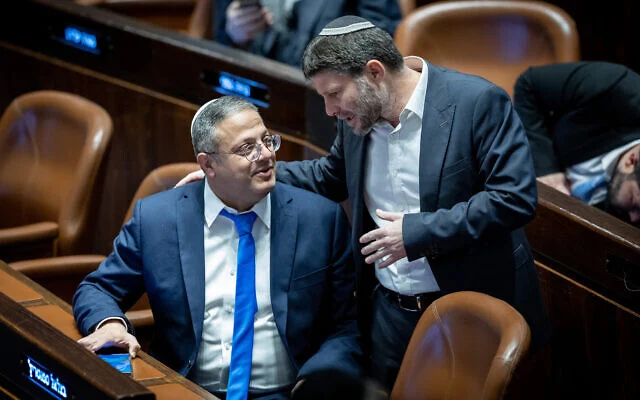
Asked whether a broader coalition would come at the expense of his current governing bloc – including the ultra-Orthodox parties and far-right ministers Itamar Ben Gvir and Bezalel Smotrich — Netanyahu rejected the idea completely.
“That’s not the question at all. I am taking the national camp, and I want to expand it — just as I did at the beginning of the war, and as I did on other occasions. We have major national missions ahead of us. And I think it is possible to reach much broader agreement than you think.”
He insisted that the Israeli public is far less divided than the political system: “I think that what exists in the Knesset, what exists in politics, includes people who want division. They want incitement. They want discord. They want fragmentation.”
Even though he argued that political boycotts should end, Netanyahu still portrayed the coming election as a choice between his leadership and a left-wing alternative: “The choice is a broad national government under my leadership, or a narrow left-wing government led by Eisenkot, together with Yair Lapid, Yair Golan, who will be dependent on the Arab parties. They don’t have another option… There is no other option.”
Asked specifically whether he would like to see figures such as Eisenkot, Naftali Bennett, Avigdor Liberman or Golan join such a coalition, Netanyahu replies: “Anyone who accepts our principles,” apparently accepting each of the lawmakers on the aforementioned list.
“I am against boycotts. We have spent ten years dealing with boycotts — over judicial matters and over a fictitious political witch hunt,” he said, referring to his ongoing corruption trial.
Parties from across the political spectrum have insisted that they will not sit in a government under Netanyahu, arguing that he has allowed his tenuous legal situation to influence the decisions he makes as premier.
As reported by The Times of Israel