
Ali Khamenei’s hand-picked deputy was believed to be coordinating Tehran’s war effort. Israel hopes the assassination will be enough to bring protestors out on ancient Persian holiday
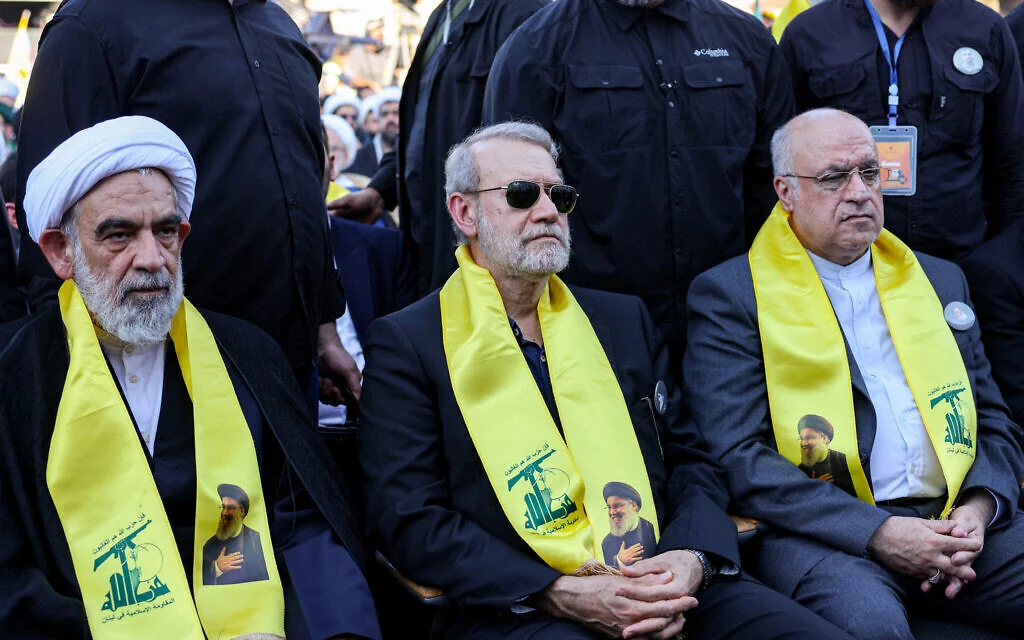
Iran confirmed on Tuesday that Israel had assassinated overnight Ali Larijani, one of the most important Iranian officials still alive.
Larijani, the secretary of Iran’s National Security Council, was the regime’s key figure after the assassination of supreme leader Ali Khamenei by Israel on February 28. He was Khamenei’s hand-picked deputy, and many viewed him as the de facto leader of the Islamic Republic following Khamenei’s death.
Khamenei “saw Larijani as the man that would inherit the Islamic Revolution and continue it,” said Jonathan Schanzer, senior vice president at the Foundation for the Defense of Democracies. “And that obviously has been seriously disrupted.”
An establishment insider who hailed from one of the country’s leading clerical families, Larijani had been tasked with taking the lead on Iran’s most pressing issues. He oversaw Iran’s efforts to reach a nuclear deal with the United States, and is widely believed to have personally directed the deadly crackdown on anti-government protests in January.
“Larijani was one of the first Iranian leaders to call for violence in response to the legitimate demands of the Iranian people,” said the US Treasury as it announced sanctions against him.
A former member of Iran’s Revolutionary Guards, Larijani served as chief nuclear negotiator from 2005 to 2007, defending what Tehran says is its right to enrich uranium. He once likened European incentives to abandon nuclear fuel production to “exchanging a pearl for a candy bar.”
In 2005, he headed the Supreme National Security Council (SNSC) for the first time.
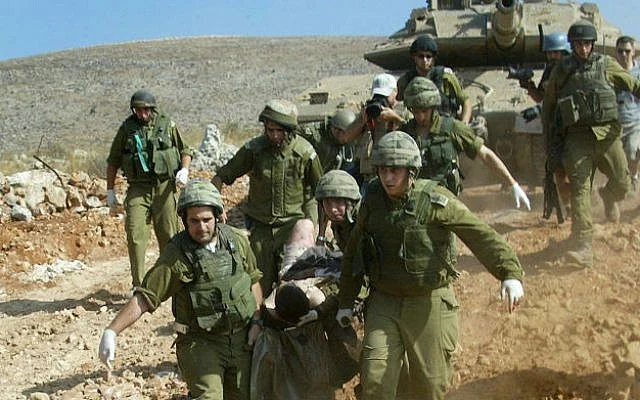
President Isaac Herzog on Tuesday accused him of masterminding the kidnapping and killing of IDF soldiers in 2006 that sparked the Second Lebanon War. “That morning he took a flight out of Lebanon,” said Herzog. “He was there as head of the national security council of Iran — he came to plan with [Hassan] Nasrallah this operation, to give him the okay.”
Larijani was speaker of the parliament from 2008 to 2020, during which time Iran negotiated and signed a nuclear deal with the US and five other powers in 2015.
He also ran unsuccessfully for president in 2005. He later sought to contest the 2021 and 2024 presidential elections but was barred both times by the Guardian Council, which cited issues including lifestyle standards and family ties abroad.
Larijani was appointed last August as secretary of the SNSC once again, following the 12-day air war between Iran and Israel that the US joined.
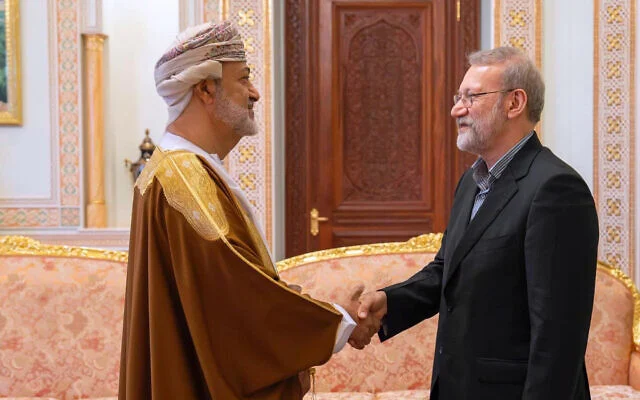
Khamenei, to whom Larijani has always shown loyalty, sent him last month to Oman to prepare for indirect nuclear talks with the US. He also made several trips to key ally Moscow in recent months to discuss a range of security issues.
“His status and influence extended far beyond any formal position he had,” said Meir Ben-Shabbat, once Prime Minister Benjamin Netanyahu’s national security adviser and now head of the Misgav Institute for National Security & Zionist Strategy.
Since Khamenei’s death, said Ben-Shabbat, Larijani “managed the fight against Israel and served as the chief coordinator of Iran’s security bodies.”
‘Unprecedented crisis’
The pressing question now is what practical effect Larijani’s assassination will have on the Islamic Republic’s ability to continue mounting a coherent military response to the US-Israeli aerial onslaught, and potentially on its very survival.
Larijani’s death comes after dozens of other senior Iranian officials have been killed in 18 days of bombing, including head of the Islamic Revolutionary Guard Corps’ Basij Force, Gholamreza Soleimani, who died in a separate strike Monday night.
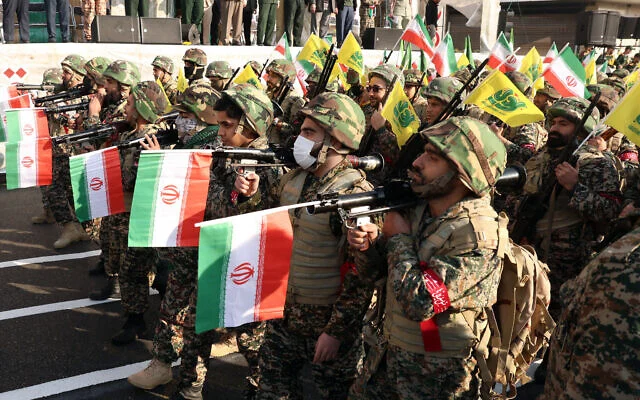
The strikes, said Ben-Shabbat, “continue the process of severing and dismantling the chain of ideological, political, and operational command and control of the Iranian regime, placing it in an unprecedented crisis.”
Right now, it’s not at all clear who’s running things. Khamenei’s son Mojtaba was selected as Iran’s third supreme leader, but he is believed to have been injured in the airstrike that killed his father, and hasn’t been seen since.
That doesn’t automatically equal the end of the regime. Iran’s proxies Hamas and Hezbollah have both suffered a series of Israeli decapitation strikes and operations, and are both still functioning.
But they didn’t have to contend with an angry populace that wants to tear down their regime.
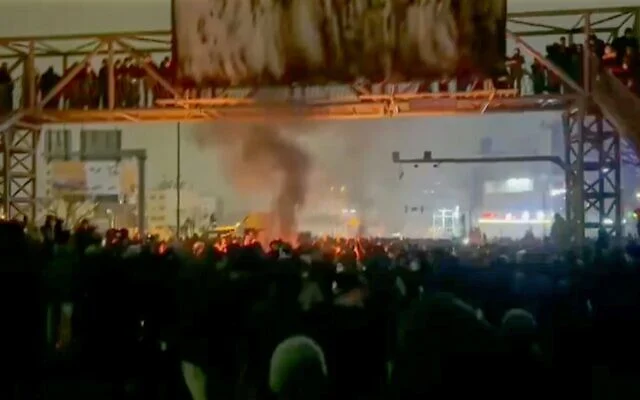
Larijani’s death, said Michael Makovsky, president and CEO of the Jewish Institute for National Security of America, “has to hearten the Iranian people, and encourage them more at some point to rise up again against the regime.”
Netanyahu is looking to take advantage of the strike immediately. In an English-language message to the Iranian people on Tuesday night, he urged them to “celebrate the Festival of Fire.”
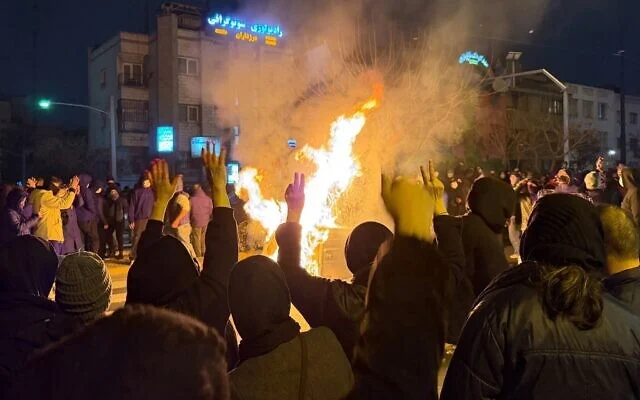
Chaharshanbe Suri is seen by the Islamic Republic as a pagan holiday, and its celebrations often feature anti-regime protests. “Celebrate and Happy Nowruz,” said Netanyahu, reassuring Iran’s people that “we’re watching from above.”
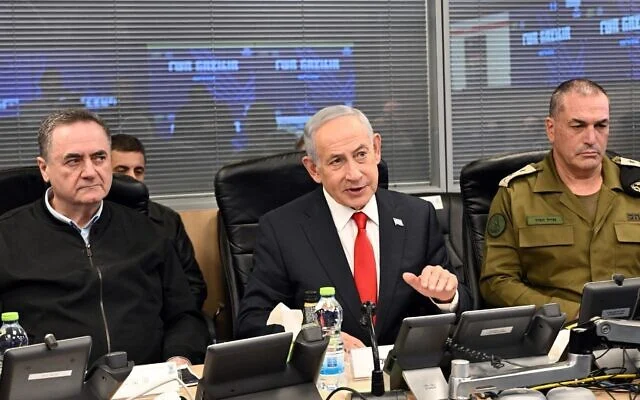
“The culling of the top leaders is absolutely going to have an impact on the way the Iranian people view what happens next,” said Schanzer.
No one knows exactly what the next stage of the war will bring, and whether the killing of Larijani will be enough to get Iranian protestors back out onto the streets.
Even if it doesn’t, Israel’s ability to locate the most important figure in the Iranian regime 18 days into war is evidence of how deeply its intelligence has penetrated the most sensitive reaches of the Islamic Republic. There are — it appears — more surprises from Israel on the way.
As reported by The Times of Israel