
On eve of PM’s visit, US president says either Iran makes a deal or ‘we will have to do something very tough’; top Iranian representative goes to Oman, meets Houthi official
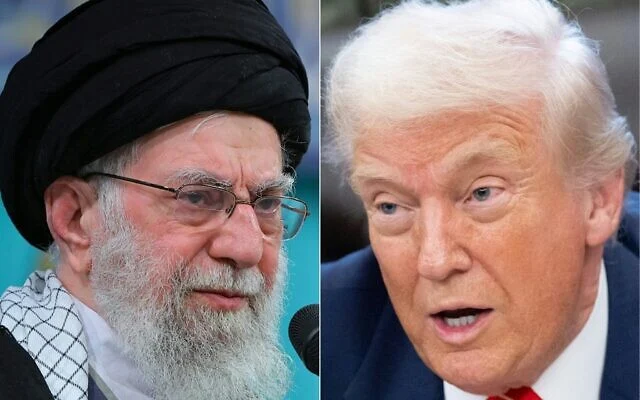
On the eve of his meeting with Prime Minister Benjamin Netanyahu, US President Donald Trump said that the Israeli premier “wants a deal” with Iran, and that the current talks on Tehran’s nuclear program show promise.
“Last time they didn’t believe I would do it,” Trump told Barak Ravid, a reporter with both Israel’s Channel 12 and the Axios news site, about the American strikes in June 2025 on Iran’s nuclear sites at the end of the 12-day Israel-Iran war, which came just days after the collapse of diplomatic negotiations.
“They overplayed their hand,” said Trump. This time, the negotiations are “very different,” he added. “We can make a great deal with Iran.”
The remarks came at a pivotal time in the tensions between the US and Iran. Trump has threatened to attack Iran over its bloody crackdown on anti-regime protesters last month, and Iran has threatened to retaliate by hitting Israel and US targets.
The US is now in the midst of negotiations with Iran over its nuclear program. Trump told Axios that it was a “no-brainer” that any deal with Iran would include its nuclear facilities, and that he expected it would be possible to include its missile program as well.
Netanyahu’s visit to Washington is expected to focus on those talks. And Trump said on Tuesday he was considering sending a second aircraft carrier to the Middle East in the event that the negotiations fail.
“We have an armada that is heading there and another one might be going,” he said, adding that he is “thinking” of sending another aircraft carrier strike group, after boosting the US military presence in the region in recent weeks.
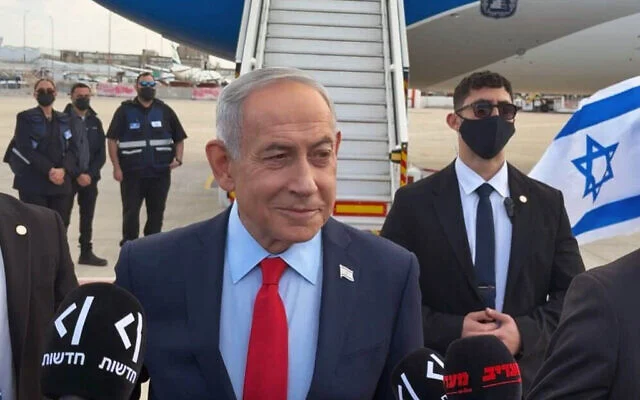
The US president also averred that Netanyahu is not against the current US-Iran talks. “He also wants a deal. He wants a good deal,” he said.
Iran, Trump said, also “wants to make a deal very badly.” But Trump told Ravid that the US isn’t afraid to play tough, saying, “Either we will make a deal or we will have to do something very tough like last time.”
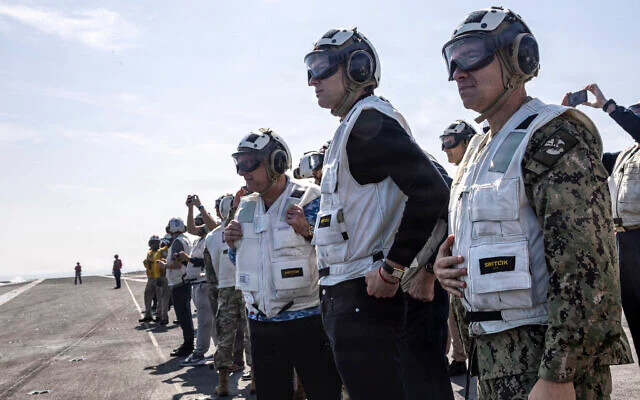
The United States moved the aircraft carrier USS Abraham Lincoln, ships and warplanes to the Middle East to pressure Iran into an agreement and to have the firepower necessary to strike the Islamic Republic should Trump choose to do so.
Already, US forces shot down a drone they said got too close to the Lincoln, and came to the aid of a US-flagged ship that Iranian forces tried to stop in the Strait of Hormuz, the narrow mouth of the Persian Gulf.
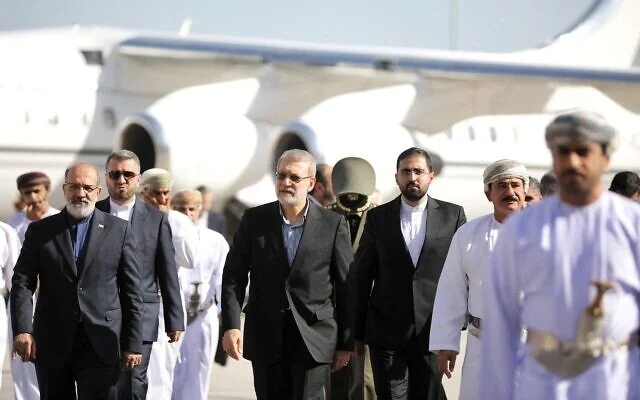
His remarks came hours after a top Iranian security official traveled to Oman, the Middle Eastern sultanate now mediating the talks between Tehran and Washington, the first since the 12-day war. The visit by Ali Larijani, a former Iranian parliament speaker who now serves as the secretary to the country’s Supreme National Security Council, likely focused on what comes next.
In Oman, Larijani’s entourage shared photos of him meeting with Omani Foreign Minister Badr al-Busaidi, the chief intermediary in the US-Iran talks, with what appeared to be a letter sheathed in plastic, and sitting alongside the Omani diplomat.
Iran has, in the past, communicated its positions in writing when dealing with the Americans. Famously, Japan’s then-Prime Minister Shinzo Abe tried to hand Iranian Supreme Leader Ayatollah Ali Khamenei a letter from Trump in 2019 that he refused to take.
Iranian media had said Larijani would deliver an important message. However, Iranian state television hours after that meeting described al-Busaidi as having “handed over a letter” to Larijani. It did not elaborate on where the letter came from.
Larijani also met with Oman’s Sultan Haitham bin Tariq for nearly three hours, the state-run IRNA news agency reported.
The pair “discussed the latest developments in the Iranian-American negotiations,” the official Oman News Agency said.
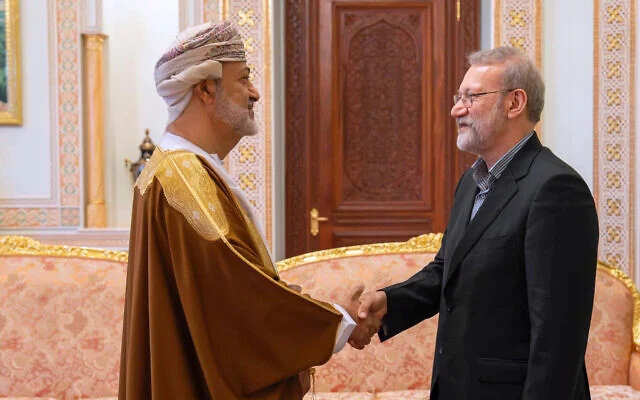
Larijani and Haitham also explored “ways to reach a balanced and just agreement between the two sides, and emphasized the importance of returning to the table of dialogue and negotiation.”
During his trip to Muscat, Larijani also met Mohammed Abdulsalam, the spokesperson for Yemen’s Iran-backed Houthi terror group.
Larijani was later to travel to Qatar, which hosts the major US Al-Udeid military base that Iran attacked in June after the US bombed Iranian nuclear sites.
He also accused Israel of trying to play a “destructive role” in the talks.
“Americans must think wisely and not allow him, through posturing, to imply before his flight that ’I want to go and teach Americans the framework of the nuclear negotiations,” Larijani said in a post on X.
Elsewhere, US Ambassador to Israel Mike Huckabee said there is “extraordinary alignment between Israel and the United States” over the talks with Tehran.
“Everyone would love to see something that would resolve without a war, but it’ll be up to Iran,” said Huckabee before he boarded a flight to Washington with Netanyahu. He said that “as far as he knows,” the US and Israel have the same red lines on Iran.
Satellite images show military buildup at Qatar base
An analysis of satellite images, published Tuesday by Reuters, appeared to indicate that Trump’s threats were serious, as they showed US forces at Al-Udeid put missiles into truck launchers, meaning they could be moved more quickly.
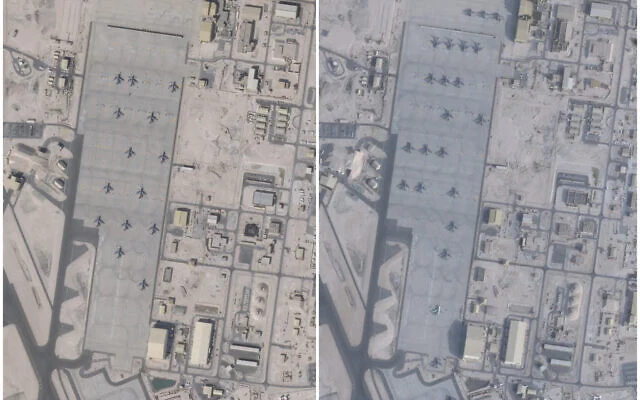
The decision to keep the Patriot missiles in mobile trucks rather than semi-static launcher stations — meaning they could rapidly deploy to strike or be moved defensively in case of an Iranian attack — shows how risks heightened as frictions grew.
A comparison of satellite photographs in early February with those taken in January shows a recent build-up of aircraft and other military equipment across the region, said William Goodhind, a forensic imagery analyst with Contested Ground.
At al-Udeid, the Patriot missiles were visible, parked mounted into M983 Heavy Expanded Mobility Tactical Trucks (HEMTT) at the start of February, Goodhind said.
“The decision to do so gives the Patriots much greater mobility, meaning they can be moved to an alternative site or repositioned with greater speed,” he said.
It was not clear on Tuesday whether the missiles were still in the HEMTTs.
A spokesperson for the Pentagon was not immediately available for comment.
The US Transportation Department’s Maritime Administration issued a new warning Monday to American vessels in the strait to “remain as far as possible from Iran’s territorial sea without compromising navigational safety.” The strait, through which a fifth of all oil traded passes, is in Iranian and Omani territorial waters. Those traveling into the Persian Gulf must pass through Iranian waters.
Iran says it has likewise replenished its missile stocks after its 12-day war against Israel. It has underground missile complexes near Tehran, as well as at Kermanshah, Semnan and near the Gulf coast. Netanyahu is expected to push Trump to curb Iran’s missile program as part of the talks.
The Iranian naval drone carrier IRIS Shahid Bagheri was visible in satellite photographs on January 27 at sea, some five kilometers (three miles) from Bandar Abbas. It was also visible near Bandar Abbas on February 10.
Iranian Foreign Minister Abbas Araghchi, speaking Sunday to diplomats at a summit in Tehran, signaled that Iran would stick to its position that it must be able to enrich uranium — a major point of contention with Trump.
“The Muscat meeting, which was not a long one, it was a half-day meeting. For us, it was a way to measure the seriousness of the other side, and to find out how we could continue the process. Therefore, we mostly addressed the generalities,” Iranian Foreign Ministry spokesman Esmail Baghaei told journalists at a news conference Tuesday in Tehran.
“Our principles are clear. Our demand is to secure the interests of the Iranian nation based on international norms and the Non-Proliferation Treaty and peaceful use of nuclear energy,” Baghaei said. “So as for the details, we should wait for the next steps and see how this diplomatic process will continue.”
As reported by The Times of Israel