
At Knesset debate, Netanyahu acknowledges argument with US, insists Hamas will be disarmed; Lapid: Either you cut a secret deal or ‘Trump doesn’t give a damn about you’
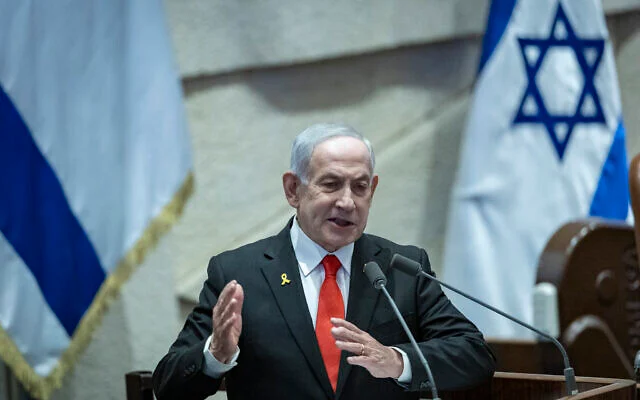
Prime Minister Benjamin Netanyahu pledged Monday that Turkish and Qatari forces would not set foot in Gaza, days after the White House announced that officials from the countries would sit on a key committee set to oversee the Strip’s postwar management.
He also acknowledged that Israel and the US had a “certain argument” about the issue.
In a speech on Monday in the Knesset, the premier also claimed that the two countries, which are hostile to Israel, will not “have any authority or any influence” in the various bodies set up by US President Donald Trump’s administration to run postwar Gaza. In fact, the US decision to include senior representatives from both countries in the committee, called the Gaza Executive Board, means they will take part in supervising the enclave.
Prior to the US announcement, Netanyahu’s office repeatedly insisted that Israel would not allow Turkey or Qatar to gain any foothold in Gaza after the war. However, following the US announcement that the countries will play a role, Netanyahu has shifted to highlighting his opposition to a Turkish and Qatari military presence there.
“Turkish soldiers and Qatari soldiers will not be in the Strip,” he said in a speech from the Knesset rostrum.
While Turkey has indeed expressed interest in joining the multinational force meant to oversee Gaza’s security, the idea has not even been entertained by Qatar, as the Gulf state’s military is not suitable for such a contribution, sources familiar with the matter told The Times of Israel.
Netanyahu made the remarks during a so-called 40-signatures debate in the Knesset, a monthly opportunity for lawmakers to compel the prime minister to speak, and answer his opponents by garnering the requisite number of signatories on a petition. This month’s debate was initiated by the Ra’am party’s Mansour Abbas, and he called the premier to account for the country’s response to rampant crime in Arab Israeli locales.
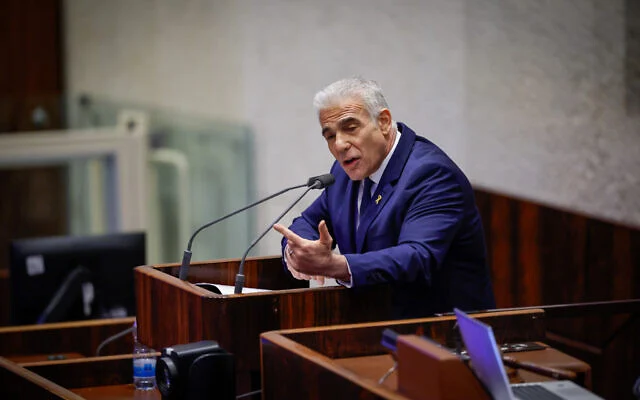
But as is customary, Netanyahu and his opponents used the session as an opportunity to attack each other on a range of hot-button issues. The stakes were raised on Monday, with the government rushing to pass the 2026 state budget, and with an election approaching later in the year.
Netanyahu, in his remarks, also promised that Hamas would be disarmed in Gaza, and threatened to strike back harshly at Iran if it attacks Israel. He claimed he had “nothing to hide” regarding his conduct surrounding the Hamas-led October 7, 2023, attack. And he took shots at Opposition Leader Yair Lapid.
Lapid, in his speech, accused Netanyahu of failure in the Gaza war, of capitulating to extremists in his coalition, and of undermining the IDF. He said the prime minister had left Israel isolated and lost trust with voters. Another opposition politician, Avigdor Liberman, wondered aloud whether Netanyahu had “forgotten what it is to be a Zionist.”
Netanyahu vows Hamas will be disarmed
Netanyahu was reportedly kept in the dark about the inclusion of Turkey and Qatar on the Gaza Executive Board.
He boasted in his speech, however, that he is willing to stand up to the US when there are disagreements over core issues. “When it comes to Israel’s essential interests, we can argue, we can sharpen our positions, and, by the way, we can come to agreements.”
He stressed that occasional disagreements do not hurt ties with Trump, “our greatest friend in the White House.”
He also claimed that Hamas would be compelled to lay down its arms, a central piece of Gaza’s phase two. And he pledged to return the body of the final slain hostage, police Master Sgt. Ran Gvili.
“Phase two says something simple: Hamas will be disarmed, and Gaza will be demilitarized,” he said. “We are sticking to those goals, and they will be achieved either the easy way or the hard way.”
Israel will ‘act with strength’ if attacked by Iran
The premier also addressed other issues of the day, including the recent mass anti-regime demonstrations in Iran. He said Israel is “following closely” developments in the country, and he praised the “heroic struggle” of the Iranian people against the regime.
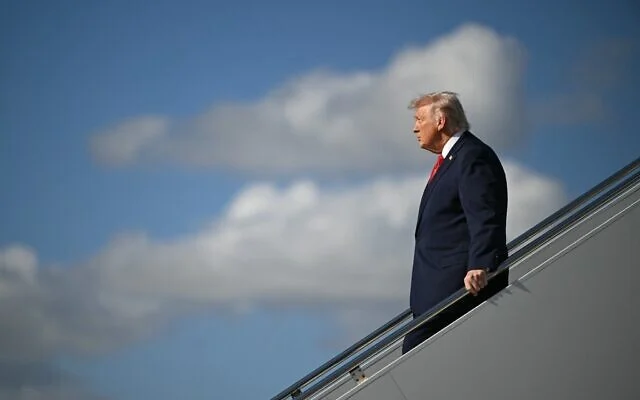
Trump had threatened to attack Iran, prompting a threat from Tehran to strike Israel in response. Netanyahu, who launched a 12-day air war against Iran last year, issued his own threat on Monday.
“If Iran makes a mistake and attacks us, we will act with strength that Iran hasn’t yet known,” he promised.
He also again defended his government’s rejection of a state commission of inquiry, Israel’s highest investigative authority, to probe the failures surrounding the October 7 attack. His government is instead advancing the formation of a politically appointed inquiry, which the Knesset opposition has vowed to boycott.
Netanyahu also claimed to have answered questions over “long hours” from the state comptroller about the October 7 attack. The prime minister’s rivals have cast doubt on the comptroller’s probe in part because he was appointed by a Netanyahu-led government.
“A day will come when the truth on everything that preceded the war and everything that happened at the time of the war — everything will be exposed to the eyes of the broader public,” he said. “I’m the first who wants everything to be presented in public. I have nothing to hide.”
That comment was met with jeers from the plenum.
Opposition leader accuses Netanyahu of ‘political failure’
Lapid, in his own speech, accused Netanyahu of mismanaging relations with the US and postwar Gaza, telling him from the podium that Trump acted “over your head.”
“Hamas’s hosts in Istanbul and Doha, Hamas’s ideological partners, have been invited to run Gaza,” said the opposition leader and chair of the Yesh Atid party, adding that the “dominant factor” in the Palestinian technocratic committee meant to govern the Strip “is the Palestinian Authority.”
He went on to claim that Netanyahu either “agreed behind our backs that Turkey, Qatar, and the Palestinian Authority would be in Gaza,” or that the premier did not know about their inclusion, which means “Trump doesn’t give a damn about you.”
He predicted that the postwar framework taking shape in the Strip could necessitate a return to war there.
“When the State of Israel is forced to return to fighting in Gaza, every soldier who is called up to the reserves will know it is because of your political failure. Absolute failure,” Lapid charged. “We are returning to Gaza, not to the starting point, but to a point much worse than at the beginning.”
The next election, he said, will hinge on which leaders can be trusted, and “you can no longer tell voters that they can trust you. You used to be able to; you no longer can,” Lapid told Netanyahu.
Liberman says Netanyahu is ‘accomplice’ of extremists
Lapid also castigated Netanyahu for working to pass a bill that will enshrine sweeping exemptions from the military draft for yeshiva students, accusing him of “promoting a disgraceful evasion law when the IDF is screaming that it lacks fighters and our children are being killed and injured by the thousands.”
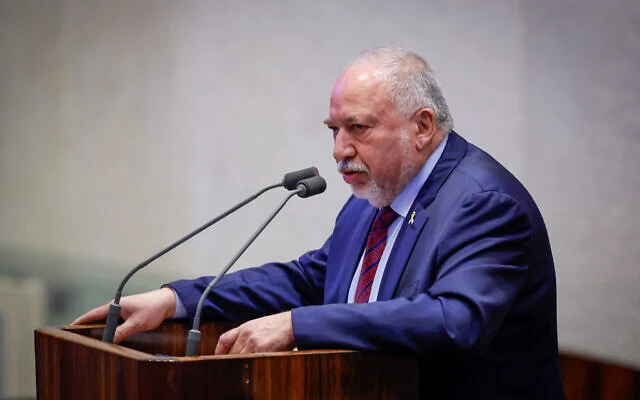
Liberman, in his speech, asked Netanyahu if he has “forgotten what it is to be a Zionist.”
“How can it be that in the heart of the State of Israel, in the city of Bnei Brak, soldiers from the Hasmonean Brigade are attacked — five soldiers wounded — and you are silent?” he asked.
Last Sunday, extremist Haredi protesters broke into a gathering held for parents of recruits to the newly formed ultra-Orthodox Hasmonean Brigade. The IDF said no soldiers were wounded.
There was “not a single response from the Prime Minister’s Office. How can it be that a soldier in uniform cannot walk around Bnei Brak?” Liberman continued. “How can it be that there are entire neighborhoods closed to IDF soldiers… and you continue to remain silent?”
Liberman added that Netanyahu “became an accomplice of those extremists,” and vowed to send the premier “to the opposition benches” after the election.
Abbas: Crime in Israel is ‘systemic failure’
Addressing the reason for which the debate was called, Netanyahu said his government is treating the issue of crime and violence in Arab communities “as a core national challenge.”
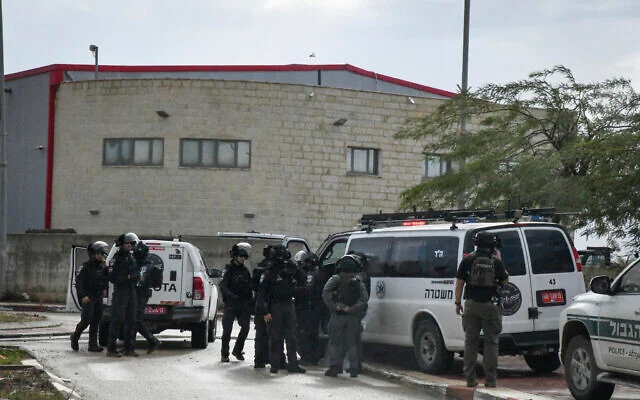
He noted that last week he took Israel’s defense, intelligence, and law enforcement leadership to the Negev to gain firsthand insights into the problem.
“Criminal organizations are terror organizations in every way,” he declared. “That is how we are treating them, and that is how we are dealing with them.”
Ra’am leader Abbas, in his speech, noted that Netanyahu has served as prime minister nearly uninterrupted since 2009 and that “over the past 20 years nearly 2,000 citizens have been murdered as part of the phenomenon of crime and violence within Arab society.”
“In the past year alone, we surpassed 250 murder victims, including 46 murdered women in Israel,” Abbas added, complaining that “for many years, thousands of citizens in Israel have been paying protection money to criminal organizations, and there is still no response.”
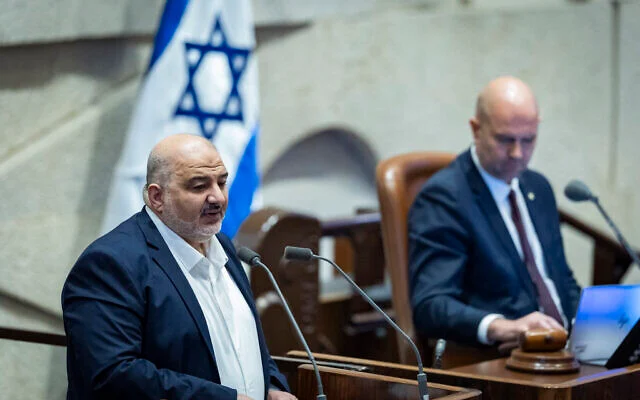
Abbas said Israelis are experiencing “a loss of personal, community, municipal, and national security” not limited to Arab society. This, he said, represents “a systemic failure — both at the policy level, in attention, priorities, and effort invested in this issue, and at the level of the day-to-day functioning of law enforcement and state authorities in general.”
Netanyahu attacks Ra’am
Netanyahu, speaking after Abbas, criticized his historically Islamist Ra’am party, indicating a likely line of attack in the election campaign.
The premier told the opposition, “In order for the Muslim Brotherhood’s Shura Council to approve Ra’am joining your government, you have simply given in to its demands.”
One of those demands, he claimed, is to turn a blind eye to Arab criminal gangs working to take control of local governments.
Ra’am has distanced itself from the Muslim Brotherhood after Netanyahu indicated he would try to bar the organization, announcing that it would become a civic party open to Jewish candidates.
Abbas has said that Netanyahu previously courted his party to join his coalition in 2021.
As reported by The Times of Israel