
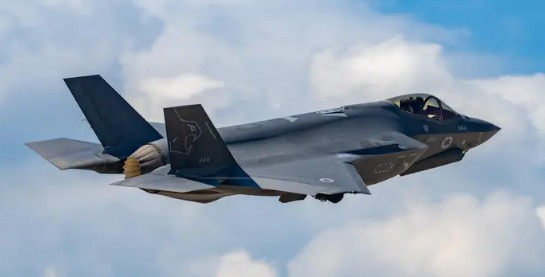
In a watershed moment for aviation history, an Israeli Air Force F-35I “Adir” stealth fighter shot down an Iranian YAK-130 combat aircraft over Tehran on Wednesday, March 4, 2026 — marking the first time in history that an F-35 has downed a manned fighter jet. While F-35s had previously engaged only unmanned aerial targets such as drones, this engagement crossed a historic threshold in fifth-generation stealth aviation combat. It also marks the first Israeli air-to-air engagement with a manned aircraft in roughly 40 years — the last being in November 1985, when an IAF F-15 intercepted two Syrian MiG-23s over Lebanon.
The downed aircraft was an Iranian Yak-130 that had been deployed on air patrol missions over the capital armed with short-range air-to-air missiles, tasked with identifying and engaging unmanned aerial threats. The Yak-130 was flying over Tehran to intercept Israeli Hermes-900 drones when it was intercepted and destroyed by the Israeli pilot. The IDF confirmed: “This is the world’s first shootdown of a manned fighter jet by an F-35.”
The Campaign: A Week of Destruction
The aerial kill came amid a devastating week of joint US-Israeli strikes on Iran. Beginning on February 28, 2026 — codenamed Operation Roaring Lion by Israel and Operation Epic Fury by the United States — the campaign targeted key Iranian military facilities, leadership, and infrastructure. By March 3, the Israeli Air Force had dropped over 4,000 bombs and conducted 1,600 sorties, surpassing the total munitions used in the entire June 2025 twelve-day war in just four days.
Iran’s air force paid a heavy price on the ground. Israeli strikes hit six airfields in western, eastern, and central Iran, destroying runways, underground facilities, and a refueling aircraft. Those strikes destroyed at least 15 Iranian fighter jets and helicopters — including F-14 Tomcats, F-5s, and AH-1 helicopters. US Air Force strikes specifically targeted multiple F-14 Tomcats at airbases across Iran. An additional Iranian aircraft was destroyed on the ground at Bushehr Airport, and Israeli strikes also hit Tehran’s Mehrabad Airport. Satellite imagery confirmed that hardened aircraft shelters at Konarak airbase were struck with precision munitions. Adding the Yak-130 downed in the air today, the confirmed total stands at 16+ aircraft eliminated, with the actual number likely considerably higher given the pace of ongoing strikes.
The Two Aircraft: A Study in Contrast
The engagement highlights a massive technological gap. The F-35I “Adir” — Hebrew for “Awesome” — is not a standard F-35. Israel is the only nation permitted to integrate its own sovereign systems into the aircraft’s architecture. It features a bespoke Israeli electronic warfare suite layered over the standard AN/ASQ-239, capable of jamming Russian-made SAM systems like the S-300 and S-400 while operating deep inside enemy territory. With full sensor fusion and 360-degree helmet-mounted display, the Israeli pilot almost certainly detected the Yak-130 long before the Iranian pilot was aware of the F-35’s presence.
Against this stood the Yak-130 — a Russian-designed advanced jet trainer and light attack aircraft delivered to Iran beginning in September 2023. While it was Iran’s newest combat jet in active service, it was never designed for high-intensity air-to-air operations. It is subsonic, with a maximum speed of approximately 1,060 km/h compared to the F-35’s Mach 1.6. It has no stealth capability whatsoever. Iran had deployed it in a combat role out of necessity, armed with R-73 short-range air-to-air missiles for drone interception patrols alongside MiG-29 fighters.
Spec Comparison: F-35I Adir vs. Yak-130
The two planes are in completely different leagues. The F-35I Adir is a cutting-edge American-built stealth fighter, customized by Israel, while the Yak-130 is a Russian-made jet originally designed to train pilots — not fight in real combat.
In terms of speed, the F-35I can fly at Mach 1.6, which is about 1,960 kilometers per hour — nearly twice the speed of sound. The Yak-130 tops out at around 1,060 km/h and can’t even break the sound barrier. The F-35I can also fly much farther, with a combat range of about 1,100 kilometers, compared to the Yak-130’s 530 kilometers. And the F-35I flies higher too — up to 50,000 feet, versus the Yak-130’s ceiling of about 41,000 feet.
One of the biggest differences is stealth. The F-35I is designed to be nearly invisible to radar, with a special shape and coating that absorbs radar signals. The Yak-130 has no stealth capability at all. The F-35I also carries one of the most advanced radars in the world — the AN/APG-81 — along with a sophisticated Israeli-built electronic warfare system that can jam enemy air defenses. The Yak-130’s radar and electronics are basic by comparison.
Then there’s the price tag. The F-35I costs somewhere between $80 and $100 million per aircraft. The Yak-130 costs around $15 million. That price difference tells the whole story — one is a top-of-the-line fifth-generation warplane, and the other is an upgraded trainer jet that Iran pressed into service because it had few better options.
Does Iran Have Anything More Advanced?
The short answer is: on paper yes, but mostly barely operational or not yet delivered. The Yak-130 that was shot down today was, remarkably, Iran’s newest combat jet in active service. Iran’s air force — often described as a “flying museum” — still relies heavily on American-made aircraft acquired before the 1979 Revolution, including the Grumman F-14 Tomcat and F-4 Phantom. Decades of international sanctions have left these platforms severely degraded for lack of spare parts.
Iran does operate MiG-29s, which are genuine air-superiority fighters and more capable than the Yak-130, but these too are aging Soviet-era jets. During the June 2025 war, Iran’s air force was so degraded that no Iranian fighter jets were reported to have left the ground at all, allowing Israel to achieve complete air superiority.
The most significant potential upgrade on the horizon is the Sukhoi Su-35 “Flanker-E” — a 4.5-generation Russian fighter. A deal for approximately 24–48 aircraft has been in negotiation for years, with deliveries reportedly set to begin in 2026. The Su-35 would represent a massive leap in Iranian capability, with superior maneuverability, an advanced Irbis-E radar capable of tracking stealth aircraft at extended ranges, and thrust-vectoring engines. There is also speculation that Iran may be the unnamed Middle Eastern buyer for the Russian Su-57 fifth-generation fighter, and Iran has also explored acquiring the Chinese J-10C as an alternative given Russian delays. None of these, however, are yet in Iranian hands in operational numbers.
Iran has also developed indigenous jets — including the HESA Kowsar, the Saeqeh, and the Azarakhsh — but these are essentially updated versions of the old American F-5 airframe from the 1950s and are considered of limited effectiveness in modern air combat.
Today’s engagement over Tehran made one thing unmistakably clear: the technological chasm between Israel’s fifth-generation stealth fleet and Iran’s current inventory is vast. The F-35I likely detected the Yak-130 long before the Iranian pilot had any awareness of its presence — a textbook demonstration of what fifth-generation sensor fusion and stealth dominance look like in actual combat.
As reported by VINnews