
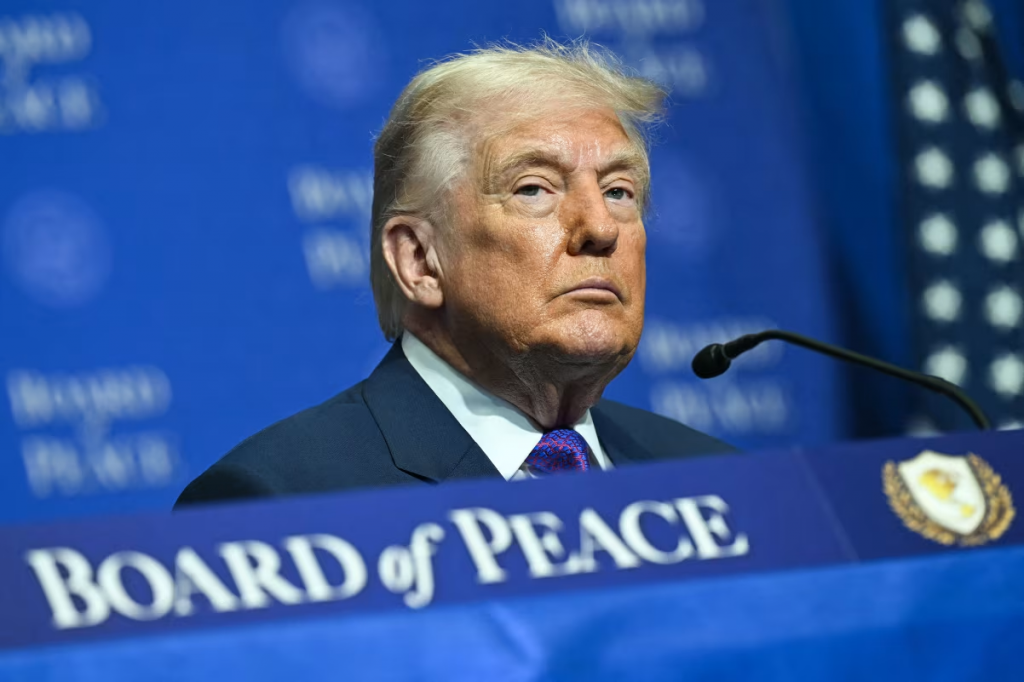
Saul Loeb/AFP/Getty Images
It’s been more than a month since President Donald Trump declared a red line on Iran.
He said that if Iran shot protesters, “we’ll be hitting them very hard where it hurts.” He told protesters to press on, with the understanding that “HELP IS ON ITS WAY.”
Trump hasn’t made good on those promises. In mid-January, he claimed the “killing has stopped,” but Iran continued killing protesters. In the weeks since, the president largely stopped talking about protesters and shifted to talking about why Iran cannot have a nuclear weapon — repeatedly threatening “bad things” if it doesn’t strike a deal.
The situation finally appears to be coming to a head, with Trump signaling a decision is arriving shortly. But Trump’s choice amounts to this: He can either enforce his red line — however belatedly — or do something quite politically fraught.
Because that’s what striking Iran would be.
To catch up: On Thursday — two days after the latest indirect talks between the US and Iran in Geneva — Trump floated his latest potential timeline for action. “You’re going to be finding out over the next, probably, 10 days,” he said at the inaugural meeting of his Board of Peace.
The US is ready to strike Iran as early as this weekend, CNN reported Wednesday, although Trump has not made a final decision, and he’s privately argued both for and against military action while surveying his advisers and allies.
Americans have largely been willing to entertain Trump’s foreign strikes, whether that’s his attacks on Iran’s nuclear sites in June, his extrajudicial strikes on alleged drug boats starting in the fall, or his ouster of Venezuelan President Nicolás Maduro last month. These weren’t and aren’t popular by any means, but they weren’t albatrosses either.
Iran presents a greater political risk.
Three polls last month showed the American people were strongly against further involvement in Iran. In each case, it was at least a 2-to-1 margin:
- They opposed missile strikes in response to Iran’s crackdown on protesters 42%-16%, per an Ipsos poll. (That poll showed 4 in 10 were neutral.)
- They opposed military action to support the protesters 67%-33% in a CBS News-YouGov survey.
- Registered voters in a Quinnipiac University poll said 70%-18% that the United States should not get involved even if protesters were killed.
Those are three pretty strong rejections of Trump’s red line. Even Republicans were against the idea in that last poll, 53-35%.
And those numbers were especially striking because some of the same pollsters showed Americans were much more evenly split on Trump’s initial Iran strikes. Quinnipiac showed twice as much support — 42% among registered voters — for the US strikes in June days after they happened.
So what gives?
Well, something we also saw in those polls last June was a distinct lack of patience — and fear — about what deeper involvement would mean.
In both the earlier CBS and Quinnipiac polls, about 8 in 10 respondents were at least “somewhat” concerned about a wider war, including 6 in 10 Republicans.
The CBS poll showed 71% of Americans thought the strikes would cause Iran to launch attacks against the United States.
A Reuters-Ipsos poll showed 79% worried at least “somewhat” about Iran targeting US civilians in response.
And Americans weren’t even that convinced the limited strikes were productive. They said 58%-27% that the strikes were actually likely to make Iran more of a threat to the United States, according to a CNN poll.
The prevailing picture from those numbers is that Americans were hardly enamored with the strikes. Indeed, they didn’t necessarily see the point and feared what the strikes could portend. But perhaps because the strikes were so short-lived, they were popular enough.
Polling on the Maduro operation in Venezuela has been similar, seemingly in part because the mission was also short-lived. And the polling on US actions in Venezuela also showed pretty substantial skepticism about deeper involvement in the country’s future.
We could find out in the coming days how serious Trump is about enforcing his red line on Iran. What’s clear is that he set himself up for a tough political choice.
A president who is already dealing with increasingly deep unpopularity is now considering making good on a quite unpopular pledge.
As reported by CNN