
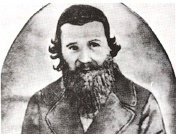
Rav Moshe Schick zt”l (1807–1879)
In Commemoration of His Yahrtzeit 1 Shevat, Tonight
By Rabbi Yair Hoffman
Ever since Matan Torah – The nation of Israel possessed a birthright – the birthright of Sinai. But others arose and wanted to take away that birthright. They struggled vehemently to remake Judaism in the image of the church. Move the bimah to the front. Face the congregation like a minister. Bring in organs and choirs. Preach in German.
And in 1868, they had the political power to force every Jewish community in Hungary to submit.
Only one man possessed the courage, the wisdom, and the authority to stop them—a man who had transformed himself from a struggling child into the greatest Torah scholar of his generation through sheer force of will and rivers of tears. His name was Rav Moshe Schick zt”l – the Maharam Schick.
This is his story.
The family name “Schick” itself carries profound meaning. According to family tradition, when the Austrian government mandated that Jews adopt surnames, the family patriarch was deeply troubled by this intrusion into Jewish identity. He declared: “I will call myself Schick”—an acronym for Shem Yisrael Kadosh (שם ישראל קדוש)—”The name of Israel is holy.” This declaration of Jewish identity would prove prophetic, as the Maharam Schick would spend his entire life defending the sanctity of that name.
The Early Years: Forged Through Adversity
Rav Moshe Schick was born on the 21st of Adar I, 5567 (1807), in the small town of Brezová (known as Rezawa in Jewish sources) in the Neutra district of the Kingdom of Hungary. This region, nestled in the Carpathian foothills of what is today western Slovakia, was then part of the vast Habsburg Empire under Emperor Franz I. The area’s Jewish communities, though subject to various restrictions, had developed a vibrant Torah culture that would produce many of the great leaders of Hungarian Orthodoxy.
His father, Rav Yosef, was a man of integrity and honesty who traced his lineage to illustrious ancestors, including the Tosfos Yom Tov and Rav Chanoch Henich Schick, the Av Beis Din of Shklov. Tragedy struck early. When Moshe was only six years old, his father passed away, leaving the young boy orphaned.
What happened next offers a powerful lesson in chinuch for all generations. The young Moshe was not naturally gifted with a brilliant mind. His own son-in-law later recorded that the Maharam Schick confided to him that as a child, he was extraordinarily slow to grasp concepts. His teachers had to explain the Talmud to him over and over again until he finally understood.
But he never gave up.
He would review and review and review until finally the material became his own. Years later, he shared the secret of his transformation with his students: “When I was young, I could not understand the Gemara on the first attempt. Not even on the second or third. So what did I do? I reviewed every lesson forty times. Forty! And each time, I wept before Hakadosh Baruch Hu. Only through this did I merit to learn and know the Torah.”
He shared another revealing memory: “When I was in yeshiva, once the Rav asked me to bring him Maseches Bava Kamma. I was so afraid I would forget the name of the tractate that I walked the entire way to the library muttering to myself, ‘Bava Kamma, Bava Kamma, Bava Kamma’…”
Yet through tremendous effort, unrelenting review, and heartfelt Tefillah – he transformed himself.
By age ten, he had memorized all of Tanach and the six orders of the Mishnah. His reputation as an illui—a prodigy of extraordinary proportions—spread far and wide. The Maharam Schick himself drew a profound lesson from his own journey: “You know,” he told his students, “the Gemara teaches that Rav Elazar ben Charsom obligates the wealthy to study Torah, and Hillel obligates the poor. And I? I obligate anyone who thinks he has no talent.”
At age eleven, young Moshe left his widowed mother to study under his uncle, Rav Yitzchak Frenkel (known as Rav Itzig Schussberg), the Av Beis Din of Frauenkirchen, a market town in the Burgenland region near the Hungarian-Austrian border. For three years he immersed himself in Gemorah study, mastering multiple mesechtos and countless sugyos by heart.
The Journey to Pressburg: A Meeting of Giants
At age seventeen, Rav Moshe made a fateful decision: he would travel to Pressburg to learn under the legendary Chasam Sofer. Pressburg (today Bratislava, the capital of Slovakia) was then one of the most important cities in the Kingdom of Hungary and home to one of Europe’s most prestigious yeshivos. The Chasam Sofer had transformed it into the epicenter of Hungarian Torah scholarship. But the young man had no money for carriage fare. Undeterred, he set out on foot, walking from village to village, town to town, until he arrived in Pressburg—just two days before Yom Kippur—with the equivalent of only four cents in his pocket.
He was small of stature and looked even younger than his years. When he approached the Chasam Sofer about joining the yeshiva, the great master looked at him skeptically. “This is for grown people, not for little children,” he said. “A bissel frimzel”—a little nothing—he called him. “I cannot take you.” But young Moshe insisted that if only the Rav would hear him out, he would see that he belonged.
What happened next would shape the course of his life. Following the Mussaf service on Yom Kippur, the Chasam Sofer delivered his customary Torah discourse to the assembled students. The slight young adolescent listened intently. Suddenly, he spoke up, offering his own insight along with a compelling proof that directly related to the Rav’s subject. The Chasam Sofer’s attention was immediately drawn to the boy. “What is your name?” he asked. “My name is Moshe of Rezawa,” came the reply.
The Chasam Sofer responded: “Moshe, you will eat at my home after the fast.” From that moment, the bond between master and student was forged. The Chasam Sofer became enamored of this remarkable young man.
Rav Moshe remained in the Pressburg Yeshiva for six years, absorbing every aspect of his rebbe’s Torah. The Chasam Sofer’s affection for him was extraordinary. For three years, young Moshe ate every Shabbos and Yom Tov meal at the Chasam Sofer’s own table. The great master referred to him as “Meine Aron Seforim”—”My walking library.”
A famous story illustrates this deep bond. Once, the Chasam Sofer traveled with his finest students, including Rav Moshe. During the journey, young Moshe fell asleep, and his head slipped onto his rebbe’s shoulder. When other students moved to wake him, the Chasam Sofer stopped them, saying: “A shelf of seforim is lying on me. You cannot move the shelf.” On another occasion, he called him a Sefer Torah Mehaleich—a walking Sefer Torah. The Chasam Sofer declared that this young man was blessed and destined for greatness.
Marriage and the Rabbinate of Yerguin
At age twenty, Rav Moshe married Gittel Frenkel, daughter of his cousin, the wealthy Rav Peretz Frenkel of Halitsch, who himself was descended from Rabbeinu Peretz, the great Baal HaTosfos. For ten years, he lived with his father-in-law, devoting himself entirely to Torah study day and night. From the day of his wedding, Torah study never ceased at his table.
In 1838, the community of Yerguin (today Svätý Jur, a small town in the Little Carpathians just northeast of Pressburg) sought a Rav. They turned to the Chasam Sofer for a recommendation. His response was decisive: “If you seek a Gaon and a Tzaddik as your Rav, take Rav Moshe Schick.”
Yerguin was a small community, almost a suburb of Pressburg—a resort area where Rav Moshe could sit and learn while serving its modest needs. He would serve there for the first twenty-five years of his rabbinic career. He founded a yeshiva that drew students from across the land, and his reputation as a posek and tzaddik spread throughout Hungary. During these years, he became recognized as an outstanding rabbinic scholar and the heir to his rebbe’s mantle as the leading halachic authority of Hungarian Orthodoxy.
His compassion for others knew no bounds and he personified the very middah of Chessed. Once, on the very day he received three months’ salary, a peasant came to him in tears. The man owed a government minister one hundred gold coins—an enormous sum—and faced death threats if he could not pay. Rav Moshe instructed him to deliver a letter to the minister. When the peasant protested that he feared for his life, the Rav told him to send it by messenger. The minister received the letter—and burst out laughing. Inside was the full payment. The Rav had quietly given his entire salary to save a fellow Jew.
A Man of Uncompromising Integrity
Every person who knew the Maharam Schick remarked on certain defining qualities: his phenomenal diligence, his meticulous honesty, his tremendous love for every Jew, and his thoughtful, weighty approach to every problem. He lived simply, content with little, and despised corruption of any kind.
When the community leaders of his later rabbinate in Khust decided to raise his salary, he refused to accept it—until they first raised the wages of the melamdin – the teachers, the shochtim and bodkim – ritual slaughterers, the Dayan – rabbinical judge, and the shamash – the sexton. Only after the communal leadership agreed to increase everyone’s pay did he consent to receive his own raise.
Once, his regular payment seemed larger than usual. He immediately summoned the sexton. “You must be mistaken about my salary,” he said. When told that the community had voted him a raise, he investigated and discovered that the same leaders had recently refused to increase the salaries of other communal employees. He would not accept the additional funds until justice was done.
His hasmadah – diligence in Torah study never wavered throughout his life. His students marveled that even while walking on the road, his lips never ceased from Torah. His piety and holiness were legendary; his students spoke in wonder of his sanctity, his self-discipline, his humility, and his pure service of Hashem.
The Master Teacher
The Maharam Schick was not merely a scholar—he was a master educator who demanded excellence from his students while guiding them with wisdom and care. Four days a week he delivered shiurim – lectures. But he never, ever gave a shiur without following it with a farher – an examination. Once, on a Yom Tov, the talmidim were in a festive mood and requested that he give a special lecture without a test. The Maharam Schick refused. “That is not what I said,” he told them, and proceeded to farher them as always.
Before Chanukah one year, he stood before his talmidim and announced: “Anyone who intends to play cards or any other games during Chanukah—please leave immediately.” Wasting time was something he could not abide.
His letters to his own children reveal his educational philosophy. To his eldest son, he wrote upon his arrival at yeshiva: “Do not do anything without thinking it through from all sides. Look at both perspectives and then decide which is correct. Every night, or at least every Friday, make an accounting of what you accomplished that day or that week—whether you achieved much or just a bit here and there. It is better to accomplish less but understand the root and foundation of what you are learning than to cover much ground without knowing what you are doing or where you are going. And do not be someone who speaks more than he thinks.”
He continued: “Everything you learn, study with a good chevrusah – a study partner. Keep reviewing, and do not wait until you forget before you review. Be careful about your health and do not do things that would damage it. Do not try to be overly pious by staying up at night more than you can handle. Take a walk every day, and discuss your learning while you walk. Cleanliness is a quality that leads to holiness, so try to be clean and meticulous.” And then, with characteristic warmth: “Answer me in a week or two, and write to your mother in Yiddish because she will not understand the Hebrew you write, and she deserves a letter.”
To a future son-in-law who had written somewhat boastfully about his learning accomplishments, the Maharam Schick responded with sharp but loving rebuke: “You write that you have a custom of thinking about Torah before going to sleep, and you share a novel idea you thought of in that state. First, it is not appropriate for a person to go around speaking about himself if he does something good. The only justification for that would be if you want someone to learn from your example. And it is not the way of wisdom for a person to talk about himself, because in the end people do not even believe it—they just think you are boasting.”
He continued: “When you write Torah to someone, you should write your best work. Do not send me things you thought of as you were drifting off to sleep. Why do you not consider that perhaps it is fantasy and not wisdom? A person works hard on Torah and learns—that is good. But you write that this just fell into your head as you went to sleep, and you think that is even praiseworthy?” He then proceeded to demonstrate that the young man’s insight was indeed flawed, and concluded: “I write these things because I want to impress upon you: Focus on learning the foundations thoroughly. Do not waste your time trying to be innovative, because genuine insights come automatically when you learn well.”
The Move to Khust: A New Chapter
On May 2, 1861, Rav Moshe accepted the position of Chief Rabbi of Khust (Huszt), a major community in the Maramaros region of eastern Hungary, nestled in the Carpathian Mountains along the Tisza River (today Khust, Ukraine). [This author owns the sefer HaZikaron for that geographic location.] This was a dramatically different world from the cosmopolitan atmosphere near Pressburg. Maramaros was a rugged, mountainous region where traditional Jewish life flourished largely untouched by the winds of reform blowing through Western Europe. Its Jews were deeply pious, and they sought a leader of commensurate stature. Khust was not merely a city—it was the center of an entire region, and its rabbi’s influence extended far beyond its borders.
His entire yeshiva—numbering some 800 students—relocated with him. In Khust, the yeshiva grew even larger, becoming one of the greatest Torah institutions of the era. Leaders of the next generation emerged from its walls. From every corner of the Jewish world, questions of halachah arrived at his door. His rulings were accepted universally as clear, authoritative decisions. His student, the Maharsham, later wrote that the Maharam Schick’s stature was equal to that of the Pri Megadim—an extraordinary tribute.
Among his most illustrious students were Rav Zalman Spitzer, Av Beis Din of Vienna; Rav Yaakov Yosef Ginz, Av Beis Din of Bessermin; and Rav David Tzvi Hoffman, who would become Rosh Yeshiva of the Berlin Rabbinical Seminary and one of the foremost defenders of Torah scholarship in the academic world, and would author the three volume Melamed l’Ho’il, aside from learned seforim on Chumash. His son-in-law and student, Rav Yaakov Segal Prager, became Av Beis Din of Ada. His great-nephew was the renowned Rav Yosef Tzvi Dushinsky zt”l, who would later lead the Eidah HaChareidis in Yerushalayim.
Respect for Local Authority
Despite being universally recognized as the leading Torah authority of his generation, the Maharam Schick maintained absolute respect for the authority of local rabbis. If he was asked a halachic question by anyone from a community that had its own rabbi, he refused to answer. He would sometimes write: “I felt the need to share my thoughts with you, but none of this can be construed as a ruling, because you have your own local rabbi.”
In several letters, he explained himself to other rabbis after unavoidable situations: “I happened to be in the town and there was an emergency. A boy whose father had just passed away faced an urgent question about the circumcision, and you were not available. That is the only reason I answered. I would never issue a ruling in another rabbi’s jurisdiction.” This was a matter of absolute principle for him.
He was equally insistent that students not publicly criticize rabbinical decisions. When he heard that Torah scholars had spoken openly against a rabbi’s ruling, he was deeply troubled. “If you have a problem,” he wrote, “go and discuss it with the rabbi privately. And if you cannot reach an agreement, take it to a rabbinical court. But to speak publicly against a rabbi’s Torah ruling? That is a terrible thing.”
The Fruits of Toil: A Phenomenal Mind
The boy who once could not remember the name of a tractate had become a living encyclopedia of Torah. A remarkable incident illustrates the extraordinary heights to which his years of toil had elevated him.
Once, the Maharam Schick encountered Rav Avraham Shmuel Binyamin Sofer zt”l, the Ksav Sofer (son of the Chasam Sofer), at a resort town. The Ksav Sofer was in the midst of writing a halachic responsum and recalled that his conclusion matched the opinion of the Tur. The problem was that he had not brought the relevant volume with him. He sent a student to ask the Maharam Schick whether he happened to have the Tur available.
The Maharam Schick sent the student back with a question: “Which siman (section) is the Rav dealing with?” The Ksav Sofer provided the number. Within a short time, a note arrived—an entire page containing the exact wording of the Tur, written by the Maharam Schick entirely from memory, word for word.
The Ksav Sofer could hardly believe it. When he returned home and entered the study hall, he opened the Tur and compared it to what the Maharam Schick had written. Not a single word was missing.
This was not a gift he was born with—it was the fruit of decades of weeping, praying, and reviewing each passage forty times over. As the Chazon Ish would later say, “Every person can become the leading Torah authority of his generation.” And indeed, we have seen with our own eyes young men who showed little aptitude in their youth yet reached the highest peaks of Torah through toil and perseverance.
This story offers hope to us all—whether we look at our children who struggle, or whether we look at ourselves. It is never too late to begin, never too late to return, never too late to succeed. All that is required is to never give up.
The Storm: Understanding the Reform Threat
To understand the Maharam Schick’s life work, one must understand the world he fought to save. At the end of the 1700s, Jews across Europe began absorbing the ideas of the Enlightenment. The pattern of departure from tradition varied by country. In France, outright assimilation was the dominant trend—Judaism faded into irrelevance as Jews melted into the broader society. In Poland, Russia, and Lithuania, the Haskalah (Jewish Enlightenment) became an end in itself—people pursued secular education and abandoned observance in varying degrees.
But in Germany, and by extension Hungary, the threat took a different form: the Reform movement. These reformers did not simply want to leave Judaism—they wanted to transform it. Their focus was the synagogue, which in Germany especially served as the focal point of Jewish identity. The changes they proposed all had a common denominator: Christian worship was viewed as more dignified, more aesthetic, more respectable. Therefore, Jewish worship had to be brought into line with it.
The prayer leader’s podium, instead of facing away from the congregation, would face them—like a Christian minister facing his flock. The central platform for Torah reading, instead of being in the middle of the synagogue, would be moved to the front—like a church altar. There would be special vestments for the clergy. There would be choirs. There would be organs. Some even proposed moving the Sabbath to Sunday. Services would be conducted in German or Hungarian instead of Hebrew. The Reform movement’s essential thrust was to make the synagogue church-like.
In 1810, a man named Jacobson opened a Reform-oriented temple in Germany that incorporated major changes from traditional worship. Reform leaders began convening conferences where twenty, thirty, or forty of these new-style rabbis would gather to propose ever more radical innovations. And unlike modern times, when anyone can simply open their own institution and attract followers or not, nineteenth-century Jewish communities operated very differently.
The Power of the Community
In those days, the money to support communal functions—synagogues, schools, cemeteries, social services—was acquired through taxes on community members. The governments, for the most part, did not wish to involve themselves in Jewish affairs, so Jewish communities enjoyed much autonomy. They could tax their members, and they did. Whoever collected the taxes held enormous power. There was no money available to build alternative institutions. Everything was controlled by the community structure.
The community’s power was even more fundamental. Most Jews did not study in yeshivos to any significant extent. The people who controlled their religious lives were the communal leaders. If you were a Jew living in a community and you were ostracized, your life was effectively over. You had nowhere to go. You could not simply melt into the non-Jewish community, because they would not accept you either—to be accepted among gentiles, you would need to be baptized. There was no alternative.
This meant that whoever controlled the community controlled everything. And this is why the battle for the communities became so critical. The Reform faction recognized this. They began enlisting government involvement, convincing officials that traditional Jews were backward and ignorant, and that the Jewish community needed to be “modernized.” They proposed that the Jews of Hungary form a Congress to reorganize communal life.
The Battle for the Soul of Hungarian Jewry
The mid-nineteenth century was a time of unprecedented upheaval for European Jewry. The Enlightenment had unleashed powerful forces of change, and the Reform movement, born in Germany, was spreading rapidly. In 1844, Reform leaders convened a rabbinical conference in Braunschweig, Germany, where they adopted resolutions that struck at the heart of Torah tradition—including the permissibility of intermarriage.
Rav Moshe Schick recognized the existential threat when many others did not.
Rav Yekusiel Yehuda Greenwald, himself a Hungarian rabbi who later served in Columbus, Ohio, and whose historical works are meticulously footnoted and documented, observed that the traditional rabbis were painfully slow to recognize the danger. They did not think the Reform movement posed a real threat. The idea of forming any centralized organization was alien to them. It was not until the reformers had already established numerous congregations that the Orthodox leadership finally awoke to the crisis.
In a letter to the Ksav Sofer, the Maharam Schick called for a gathering of Torah rabbis to formally address the danger: “In any case, I do not know why we should not publicize the truth—what is the status of these people according to our holy Torah. Since they have denied Torah from Heaven, as their many statements and heretical books testify, they are not Jews, but are like complete non-Jews.” He described the Reform leaders in devastating terms: “They are not rabbis but Karaites. They don the cloaks of rabbis in order to deceive and to act like the serpent.”
The political situation in Hungary made matters even more complex. In 1848, revolution swept through the Habsburg Empire, and Hungary briefly achieved semi-independence before being crushed by Austrian and Russian forces. The subsequent years of absolutist rule gave way to the Austro-Hungarian Compromise of 1867, which created the Dual Monarchy and granted Hungary significant autonomy. For Hungarian Jews, this meant new opportunities—but also new dangers, as reformers sought to use the changing political landscape to reshape Jewish communal life.
The Hungarian Jewish Congress of 1868–1869
In 1867, the Hungarian government, now enjoying its new autonomy within the Dual Monarchy, passed legislation granting Jews civil equality and communal autonomy. The Neolog (Reform) faction immediately demanded a congress to create a unified national Jewish organization that would govern all communities—Orthodox and Reform alike. For the Maharam Schick, the stakes could not have been higher. A unified structure under Neolog dominance would mean the slow strangulation of authentic Torah Judaism.
In 1868, the Jewish Congress convened. By all accounts, the Reform faction managed to secure disproportionate representation. The Orthodox attempted a compromise: the one foundational principle of the new organization would be that the Shulchan Aruch—the Code of Jewish Law—would be binding on everyone. They were voted down. With that, the vast majority of the Orthodox rabbis walked out of the Congress.
Though he held no formal organizational position, the Maharam Schick emerged as the de facto leader of the Orthodox resistance. At the Budapest Congress of 1868–1869, held in the grand Hungarian capital on the banks of the Danube, he fought tenaciously for complete separation from the Reformers. In a lengthy responsum (Orach Chaim 309), he detailed every plan and proposal of the Neologim to justify his position. His voice rang out like a shofar, calling the faithful to stand firm.
The Orthodox appealed to the king for permission to form their own separate communal structure. The request was granted. The Austrian parliament in Vienna recognized the Orthodox claim for an independent communal organization. The Landes-Organisations Statuten were formulated and confirmed in 1871, establishing separate Orthodox communities throughout Hungary. This was a historic victory—one of the few times in modern Jewish history that Orthodox communities achieved legal recognition of their right to separate from heterodox movements.
Hungarian Jewry was now divided into three groups: the Neologs (essentially equivalent to Reform today), the Orthodox (called “Chareidim”), and a small group of communities that refused to affiliate with either side, preferring that things remain as they had always been. These were called “Status Quo” or “Status Quo Ante” communities.
The Maharam Schick understood that half-measures would not suffice. The Orthodox in Hungary made a fateful decision: they would cut themselves off totally from the Reform communities.
They did so completely. One could not marry their children. One could not eat in their homes. They truly separated the two camps. The Maharam Schick ruled that any religious functionary—regardless of personal observance—who served a non-Orthodox community automatically forfeited his standing among the Orthodox.
He also battled the Status Quo communities, believing that if each community remained independent, it would eventually be captured by the Reform faction. For the Maharam Schick, neutrality was impossible when the soul of the Jewish people hung in the balance. The clarity of his vision ensured that Hungarian Orthodoxy would survive as a distinct, vibrant force.
Wisdom and Discernment
The Maharam Schick’s greatness lay not only in his fierce defense of Torah but in his wisdom to distinguish between genuine threats and matters of legitimate debate. In 1865, a group of zealous rabbis gathered in Michalovce (in northeastern Hungary, today Slovakia) under Rav Hillel Lichtenstein and issued a halachic ruling prohibiting entrance into synagogues that had made even minor aesthetic changes—including delivering sermons in the German or Hungarian vernacular.
Rav Greenwald, in his historical analysis, felt this was a serious tactical error. The Reform movement’s greatest asset was their powerful speakers—preachers who could speak eloquently and sway audiences. In Germany, Rav Samson Raphael Hirsch was a masterful orator—phenomenal, powerful, inspiring, extremely articulate. There were similarly gifted speakers among the Hungarian Orthodox who could deliver sermons in Hungarian. By prohibiting vernacular sermons, Greenwald argued, the Orthodox were shooting themselves in the foot.
The Maharam Schick shared this view. He carefully examined the draft legislation and found it halachically problematic. He refused to sign even the softened final version, particularly objecting to the blanket ban on vernacular sermons. He wrote with characteristic precision: “In the case of a God-fearing man, whom we are certain is a Talmudic scholar, who preaches in the vernacular with the sole intention of extending the border of our holy Torah… I find no reason to forbid him where the congregation only wishes to listen in the vernacular, or if he does not do so they will appoint another who is unfit.”
This was not weakness but wisdom. The Maharam Schick understood that banning a practice that was halachically permissible would only undermine rabbinic credibility and push communities toward unqualified leaders. His own son had studied at Rav Esriel Hildesheimer’s innovative Eisenstadt yeshiva, an Orthodox institution that included secular studies alongside rigorous Torah learning. He recognized that Orthodoxy could accommodate diversity in approach while maintaining unity in principle.
Yet once the Michalovce declaration was issued and publicly accepted by the majority of his colleagues, he graciously deferred to their collective judgment. “My colleagues overwhelmed me,” he acknowledged, recognizing that communal unity among the Orthodox justified accepting stringencies beyond his own position. When someone later acted against the accepted ruling, he criticized them: “I thought it was correct. I still think it is correct. But when the majority voted against me, we must go with the majority.” This was the mark of a true Torah leader—one who could fight fiercely for his principles while maintaining the humility to subordinate his individual opinion to the greater good of the Jewish people.
The Sanctity of Custom
Because the Reform movement’s primary thrust was to change synagogue minhagim – customs and rituals, the Maharam Schick was intensely protective of all halachos and minhagim traditional practices. He ruled that it was forbidden to pray in a synagogue where the central platform had been moved from the middle, or where other architectural changes had been made to resemble a church. He was meticulous about preserving even minor customs.
When someone wrote to him that they had moved the rabbi’s sermon from before the Torah reading to before the Mussaf service—because people coming and going during the earlier slot were disruptive—he responded: “It is best not to change any customs. If you have absolutely no choice and it is truly impossible otherwise, then it may be permitted—it is not a strict halachic prohibition. But as a general principle, minhagim should be preserved.”
Why such stringency about customs? Because in Germany and Hungary, the battleground was precisely there. If you gave an inch, you gave a foot, and eventually you gave everything away. People today sometimes quote Hungarian authorities for their firm stance on customs and wonder at what seems like excessive rigidity. But it was true in Hungary—the sense was that the battle for Judaism would be won or lost on the field of minhag (custom). The same dynamic existed in Germany, where Rav Samson Raphael Hirsch’s community became fanatic about preserving every tradition because that was the only way to stop the slide.
A descendant of the Chasam Sofer who lives in Toronto once shared a fascinating teshuvah: Someone had asked whether it was permissible to transport a deceased person by horse and wagon instead of carrying the body on foot as was customary. The Maharam Schick wrote that certainly it is not appropriate to change from established custom, but if there is a very significant need, it may be permitted. A hundred years later, someone asked whether one must use a horse and wagon or may use a car—and again, the question of changing from custom arose. The pattern reveals the depth of his commitment to preserving tradition while maintaining halachic integrity.
Navigating the Chassidic Question
Another complex challenge of the era was the relationship between the established rabbinate and the growing Chassidic movement. Chassidim were spreading into Hungarian communities, and they wanted to establish their own prayer quorums and their own ritual slaughter. Local rabbis often objected: “I am the Rav. There is one synagogue, one prayer service. You cannot do this.” Some Rabbonim even ruled that Chassidic slaughter was not kosher, using their authority as local religious leaders to forbid it.
The Maharam Schick navigated these tensions with remarkable wisdom. He himself had a fascinating relationship with the Chassidic world. He was extremely close to the Rebbe of Sighet, the forerunner of the Satmar dynasty, known for his extraordinary tzidkus and yiras shamayim. Whenever someone came to the Maharam Schick seeking blessings, he would send them to the Rebbe. “He knows how to give brachos – blessings,” he would say. “Go to him.” Once, the Rebbe joked with him: “I am so tired of you sending people to me. Let me teach you how to give blessings, and you will be able to do it yourself.”
On the other hand, there was a different Rebbe who lived in the Maharam Schick’s own town and never once came to pay his respects. When someone asked him about this apparent disrespect, he responded diplomatically, recognizing that these were two very different situations.
His responsa reveal his practical approach. When the Rav of Klausenburg, Rav Glasner, complained that Chassidim had opened their own minyan – prayer quorum and essentially formed their own community, the Maharam Schick responded with a pragmatic ruling: “Listen, what they did may not have been appropriate, but it is not wise to try to stop it. Let it be. They have no right to reduce your salary—they must continue supporting you. But you should not try to prevent them from doing what they are doing. Only go to a Beis Din – a rabbinical court if there is a monetary dispute about dues or support. But as for whether what they are doing is right or wrong—leave them alone.”
When a dispute erupted in one town where a Chassid had declared that the Viznitzer Rebbe was “the leading Torah authority of the generation”—a claim that the local rabbi found offensive—and the Chassidim had responded by humiliating the Rav publicly and cutting his salary, the Maharam Schick issued a powerful letter. He validated the rabbi’s honor, declared the actions against him to be without halachic basis, and urged the Chassidic community: “How long will you destroy things and burn with fire? There is no honor for Chassidus itself in such behavior. I am certain the Rebbe does not want this to happen.”
His guiding principle was clear: the Chassidim, despite whatever disagreements existed about their methods, were God-fearing and committed Jews. One had to find a way to live with them, because the future of Judaism depended on unity among the observant. When someone suggested resolving disputes with Chassidim through formal halachic debate and proofs, he dismissed the idea as naive: “There will be no resolution through arguments and proofs. No one ever won that way.” His advice was always practical, always aimed at preserving peace among those committed to Torah.
Leadership Beyond Hungary’s Borders
The Maharam Schick’s influence extended far beyond Hungary. In 1876, a controversy erupted in Germany between Rav Samson Raphael Hirsch of Frankfurt, who demanded complete separation from Reform communities, and Rav Seligmann Baer Bamberger of Würzburg, who permitted remaining in unified communities. German law had just made it possible for Orthodox Jews to legally secede from the general Jewish community—but should they?
The Maharam Schick weighed in decisively on Rav Hirsch’s side, drawing on his own hard-won experience from the Hungarian struggle. “We are commanded to separate from them,” he wrote to Rav Bamberger, “until the sinners are considered like excised flesh that falls away and is lost, while the rest of the body is saved. It is forbidden to have any contact with anything of theirs.” His voice carried enormous weight. Under his influence, Rav Hirsch’s position of separation prevailed, and Frankfurt’s Orthodox community established its independence—a model that would inspire Orthodox communities worldwide.
Love for Eretz Yisroel
The Maharam Schick’s love for Eretz Yisroel and its Torah community was profound. When the decidedly anti-frum German-Jewish historian Heinrich Graetz visited the Holy Land and returned with a scathing report attacking the traditional Jewish community there, the Maharam Schick rose to their defense.
Graetz’s complaints were several: There was too much internal politics and factional fighting among the different groups. Even wealthy people accepted funds from the chalukah—the charitable distribution system that supported Torah scholars in the Holy Land. He claimed that because they married young, they had sickly children and high rates of abnormalities. And he charged that they had no proper schools and were therefore primitive and ignorant.
The Maharam Schick responded sharply to each charge. Regarding the internal disputes: “Yes, it would be better if there were unity. But until Moshiach comes, unfortunately, that is not going to happen. So what is the point of this complaint?” Regarding the health claims: “I have never seen or heard anything like this. No one is talking about such things.” Regarding the chalukah: He defended the system, recognizing that the Jews of the Land of Israel, living in poverty under Ottoman rule, were preserving the holiness of the Land through their Torah and prayers. Their support was not charity but a sacred partnership. Graetz’s attack, he understood, was motivated by a desire to delegitimize the traditional community—nothing more.
A Legacy of Learning
The Maharam Schick was a prolific author whose works remain essential to Torah scholarship. His magnum opus, She’elos U’Teshuvos Maharam Schick, contains over 1,000 responsa covering every area of Jewish law: 345 on Orach Chaim, 410 on Yoreh De’ah, 155 on Even Ha’Ezer, and 62 on Choshen Mishpat. From across the Jewish world, the most difficult questions were sent to him, and his rulings were accepted as clear, definitive decisions. Beyond the responsa, his works also include letters that reveal much about his life, his relationships, and his approach to the challenges of his era.
He also composed a major work on the 613 commandments, similar in style to the Minchas Chinuch. Remarkably, when Rav Yosef Babad’s Minchas Chinuch was published first in 1869, the Maharam Schick was distressed, saying the latter had anticipated half his work. Out of humility, he abbreviated his own commentary—though it remains a masterwork in its own right.
Additional works include his commentary on the Torah (Maharam Schick al HaTorah), on Pirkei Avos, on the Pesach Haggadah, novellae on Tractate Chullin, and collected sermons from his decades of rabbinic leadership. His son Yosef published many of these posthumously, ensuring that future generations would benefit from his father’s wisdom. A biographical collection called Darchei Moshe HaChadash preserves extensive quotations from his students and children about his life and ways.
Final Days and Lasting Impact
According to the testimony of his closest students, from the time of the Hungarian Congress, the Maharam Schick lived with a heightened sense of responsibility, ever vigilant against threats to Torah Judaism. He understood that eternal watchfulness was the price of preserving Torah in a rapidly changing world, embodying the words of Proverbs (28:14): “Blessed is the man who is constantly in fear.”
The Maharam Schick was niftar on the 1st of Shevat, 5639 (1879), after a period of great suffering that he bore with characteristic strength and faith. He was buried in Khust, where his resting place became a site of pilgrimage for generations of Yiddin seeking to connect with his Kedusha – holiness.
The Yeitiv Lev (Rav Yekusiel Yehuda Teitelbaum of Sighet) delivered the Hesped – the eulogy with profound grief. Using the metaphor of Hebrew vowels, he lamented: “My brother, my brother Moshe! As long as the holy Rav Shmelke of Selish was alive, we were like a segol (three dots). After his passing, we remained like a tzeirei (two dots). And now, I remain alone like a chirik (a single dot).” The loss was immeasurable.
Conclusion
The Maharam Schick was the architect of Hungarian Orthodox Judaism. He laid down the framework for how Torah yidden would live for generations to come. The idea of complete separation from heterodox movements, the insistence on preserving every custom, the power of strong communal structure and rabbinic authority—all of these flowed from his leadership.
A great Torah scholar who had studied in both Lithuanian and Hungarian yeshivos once reflected on his travels through Eastern Europe before the war. He said that the only country where authentic Torah Judaism would have survived indefinitely, had the Holocaust not intervened, was Hungary. Everywhere else, he observed, things were declining. Only in Hungary did he see a viable, thriving community that could continue. And he said this not as a partisan—he was a Lithuanian through and through—but out of honest recognition of what the Hungarian system had achieved.
That system was built by the Maharam Schick: the strength of the rabbinate, the strength of the community, and the wisdom to understand that the Chassidim—despite disagreements about their methods—were true Yorei Shamayim with whom one must find a way to live, because the future of Torah depended on it.
His students carried his Torah to Vienna, to Berlin, to communities throughout Hungary and beyond. His works remain studied and revered. The independent Orthodox communities he fought to establish survived the upheavals of the twentieth century, and his spiritual descendants continue to illuminate the Jewish world. The separation he championed in Hungary became a model for Orthodox communities everywhere, ensuring that authentic Torah Judaism would not be submerged beneath the rising tide of assimilation.
In the waning days of the Maharam Schick’s life, when illness had confined the great sage to his bed, the Yeitiv Lev of Sighet came to visit him. Between these two giants of Torah scholarship there existed a bond of profound mutual admiration—a love forged through years of shared devotion to learning and service.
The Yeitiv Lev seated himself close to the bedside and gently placed his hand upon the mattress. From time to time, the Maharam Schick would take his visitor’s hand and bring it to his lips, kissing it with reverence.
As they sat together, the Yeitiv Lev expounded on a passage from Berachos. When Rabbi Chiya bar Abba fell ill, Rabbi Yochanan came to him and asked, “Give me your hand.” The Gemara uses the phrase yahav lei yedei—and within those words, the Yeitiv Lev discerned hidden meaning. The divine name Keil is embedded there, one of the sacred names associated with healing. And from the verse l’ma’an yeichaltzun yedidecha—”so that Your beloved ones may be rescued”—one can derive chalitzaso chama, a remedy for illness. Thus, the simple act of taking another’s hand contains within it a segulah for recovery.
Then the Maharam Schick turned to his visitor, his voice heavy with bewilderment.
“Great Rebbe,” he said, “I do not understand why such terrible suffering has come upon me.”
The Yeitiv Lev responded gently, invoking the Gemara’s teaching: “Let a person examine his deeds.”
But the Maharam Schick—then approximately seventy years old—shook his head. “Bitul Torah gefin ich bei mir nisht,” he said in Yiddish. “Neglect of Torah study? I cannot find any such failing within myself.”
The Yeitiv Lev quickly clarified his intention. “Chas v’shalom—Heaven forbid—that is not what I meant. Rather, one should pray to Hashem and say: ‘This suffering is preventing me from learning Torah. The world needs my teaching, and I wish to study. Therefore, please remove these afflictions so that I may serve You in complete health, without interruption.’”
The Maharam Schick understood. “And what merit do I possess to make such a request?”
“Only koach—strength,” the Yeitiv Lev replied. Then he quoted from Yeshayahu: V’kovei Hashem yachalifu koach—”Those who hope in Hashem will exchange their strength.” The deeper meaning, he explained, is this: We acquire strength from the Holy One, Who “gives strength to the weary.” And how is this exchange made? Through emunah and bitachon—faith and trust. When we offer our faith, Hashem grants us renewed strength in return.
On the journey home, the Yeitiv Lev shared his astonishment with his son, Rav Moshe.
“Did you hear what the Rav of Huszt said? He testified that he has already searched through every action of his entire life. He has scrutinized every word he has spoken, every thought he has entertained. And he could find within himself no transgression that would warrant such suffering. Not even the sin of bitul Torah could he discover.”
The Yeitiv Lev paused, contemplating the mystery.
“Why, then, has such terrible affliction befallen him? It remains beyond understanding. One can only conclude that these are yisurin shel ahavah—sufferings of love, bestowed by Heaven upon the righteous for reasons known only to the Almighty.”
This account was transmitted by Rav Mordechai Williger zt”l, who heard it from his father, Rav Moshe Williger z”l, a devoted talmid of the Yeitiv Lev.
Perhaps most importantly, the Maharam Shick’s life story—from a struggling child who could barely remember the name of a tractate to the leading Torah authority of his generation who could reproduce entire sections of the Tur from memory—stands as eternal testimony that greatness is not a gift but an achievement. Through tears, through prayer, through reviewing each lesson forty times, he transformed himself into a vessel of Torah. His example calls out to every Jewish child, every Jewish adult, every Jew who has ever doubted their own potential: It is never too late. Never give up.
As reported by VINnews