
Measure aims to add NIS 31 billion to the 2025 state budget, with the increase accompanied by an across-the-board cut to ministerial budgets
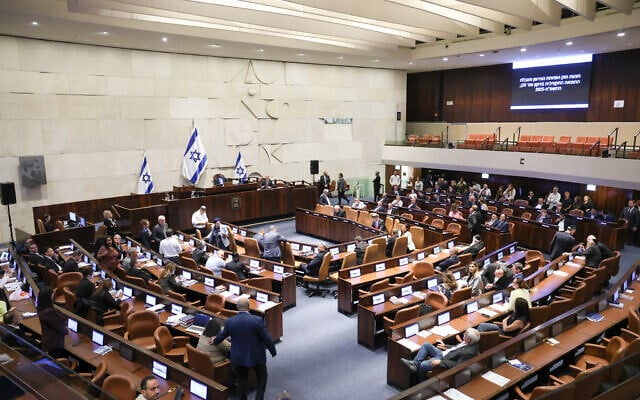
Lawmakers on Wednesday evening voted 42-37 in favor of the first reading of a bill approving an increase of NIS 31 billion ($9 billion) to the state budget, most of it to bolster the defense budget, with NIS 1.6 billion ($473 million) in funding for humanitarian aid to Gaza.
The increase will be accompanied by an across-the-board cut of 3.35 percent of ministerial budgets set to go into effect at the beginning of next year.
The bill, which aims to raise the budget for the 2025 fiscal year to around NIS 786.7 billion ($236 billion), will now be referred to the Knesset Finance Committee to be prepared for the final two readings it must pass to become law.
Its advancement came shortly after MKs voted 48-40 in favor of the first reading of a bill to raise the deficit ceiling for 2025 to 2.5%.
The bill’s passage was in doubt for much of Wednesday, as various right-wing and religious parties threatened to prevent it from advancing unless their demands — fiscal and otherwise — were met.
Ahead of the vote, National Security Minister Itamar Ben Gvir’s ultranationalist Otzma Yehudit party threatened to oppose the budget increase unless NIS 80 million ($23.9 million) in funds intended for the Settlements and National Projects Ministry, controlled by a Religious Zionism lawmaker, was instead transferred to the Negev, Galilee and National Resilience Ministry, headed by his party’s Yitzhak Wasserlauf.
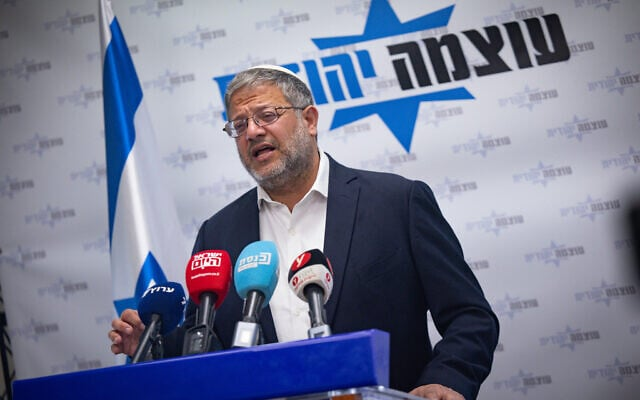
As lawmakers loudly debated the bill, however, Otzma Yehudit released a statement that it had reached an accord with the coalition for an additional NIS 160 million ($48 million) to pay for reserve service days for members of the police.
“It was also agreed that negotiations will resume to restore what was taken from the Negev and Galilee and Heritage ministries — and this will be settled before the second and third readings,” Otzma Yehudit said in a statement.
The Knesset Finance Committee is slated on Thursday to discuss transferring budget surpluses from the 2024 fiscal year, including over NIS 28 million ($8.4 million) for the Heritage Ministry run by Otzma Yehudit’s Amichay Eliyahu.
Coalition whip Ofir Katz (Likud) also confirmed the agreement, telling lawmakers that the money would be transferred to pay for Border Police officers’ reserve duty.
However, Finance Minister Bezalel Smotrich’s office denied that any deal was on the table, saying in a statement that “contrary to claims, the Finance Ministry did not commit to transferring NIS 160 million to the National Security Ministry and certainly not to open budget issues unrelated to the war.”
“The budget approved today in its first reading is intended to finance the war. Its transfer is essential to Israel’s security and to the functioning of all government ministries, and all coalition members must act responsibly and not exploit this to create artificial crises or to extract budgets unrelated to the war,” the statement added.
Smotrich, who heads Religious Zionism, is currently on an official visit to India.

Since the coalition and opposition are deadlocked with 60 seats each, Ben Gvir’s opposition posed a risk to the advancement of the budget increase, although the absence of multiple opposition MK who are abroad — including Opposition Leader Yair Lapid and Blue and White-National Unity chairman Benny Gantz — tempered the threat.
Ultra-Orthodox anger
In a statement ahead of the vote, Degel HaTorah announced that its MKs would abstain because the coalition has failed to meet its commitments to the ultra-Orthodox faction.
However, the Haredi faction also wouldn’t vote against the measure since “the amendment being presented today is exclusively for the needs of the security establishment and does not involve any cuts to civilian provisions” of the budget, the statement explained. It added that ahead of further votes on the bill, the party’s decision-making rabbinical Council of Torah Sages “will instruct [MKs] on how to vote.”
After the multi-billion shekel budget increase was approved by the cabinet last month, Degel HaTorah chief Moshe Gafni appeared to threaten to vote against the increase due to a cut of NIS 481 million ($142 million) in taxpayer money set aside for Haredi schools’ eventual inclusion in the government’s New Horizon program, which funds work in small groups between teachers and pupils and bumps up teacher salaries, among other initiatives.

As Haredi schools, which do not teach core subjects such as math or science, have been excluded from the program, the money was being set aside until the law is changed to allow the funds to be allocated.
According to financial newspaper The Marker, the decision to abstain came after Gafni was promised compensation for the lost funding.
The Hasidic Agudat Yisrael faction, which together with Degel HaTorah makes up the larger United Torah Judaism party, took a different approach, announcing that it would vote against the budget.
The Haredi Emess website quoted Agudat Yisrael chairman Yitzhak Goldknopf as saying that “instead of the demonstration tomorrow, we will hold a demonstration in the plenum and vote against the budget that provides oxygen to the government. I invite members from all the Haredi factions to join the protest.”
The Haredi parties were slated to hold a massive series of anti-conscription protests across the country on Thursday but they were called off. Both Agudat Yisrael and Degel HaTorah left the coalition over the enlistment issue this summer.

Goldknopf was photographed entering Knesset Foreign Affairs and Defense Committee chairman Boaz Bismuth’s office earlier Wednesday, but it appeared they failed to come to an agreement that would secure the Haredi party’s support.
Speaking in the Knesset plenum ahead of the vote, Goldknopf called to increase educational funds for Haredim and exempt yeshiva students from conscription.
A deal with Shas
Unlike the two other Haredi factions, MK Aryeh Deri’s Shas did not oppose the budget increase, with the financial website Calcalist reporting that in exchange for its support, ministries until recently controlled by the ultra-Orthodox Sephardic party would receive tens of millions of millions of shekels in additional funding.
According to the report, the Knesset Finance Committee is slated o approve NIS 80.5 million ($24.2 million) for the Religious Affairs Ministry, on top of the government’s recent approval of NIS 40 million ($11.9 million) in state funding to ultra-Orthodox schools affiliated with the party’s Bnei Yosef educational network.
Shas left the government over the summer to protest its failure to pass a bill exempting yeshiva students from military service but remained part of the coalition. Its ministerial portfolios were temporarily handed to a pair of Likud ministers in the hopes that the party will return to government soon.

In a tweet, opposition Knesset Finance Committee member Orit Farkash Hacohen complained that in the middle of a war, the government was allocating “more and more money to grease the coalition” while “our state services will be cut.”
Speaking with The Times of Israel following the vote, Yesh Atid MK Vladimir Beliak, who also serves on the committee, criticized the government over its handling of the budget, arguing that it had “once again failed in its ability to meet the deficit target and manage a responsible fiscal policy.”
“They are deepening the hole in the budget, carrying out an extraordinary across-the-board cut in education, health, and welfare, and yet still refuse to cancel coalition funds and close 15 unnecessary ministries,” he said.
As reported by The Times of Israel